This month's Mixology Monday is being hosted by Jordan of Chemistry of the Cocktail. His blog is one of my favorites currently, which has really gotten into a groove during this last year of 2012. Do yourself a favor and put his site onto your RSS feed or your weekly rounds.
Jordan's theme for this month is fortified wines. Why does he seem to exclude vermouth from this theme? Probably because vermouth would be too easy. Either way, I'm up for the challenge.
This is a drink that I created years ago and return to often. It began, as things do, when I was trying to drain some almost-dead bottles in my playroom.
In creating the drink, I realized that brandy and Madeira go very well together but that it was missing something. As with many cocktails, it was bitters that it needed to tie the other ingredients together. Let that be a lesson, if you've not already learned it.
Original Remix
Later That Day
1.5 oz Cognac (or brandy)
1 oz Madeira (substitute Amontillado sherry if you must)
1 dash orange bitters
1 dash simple syrup
Build over ice in an Old Fashioned glass. No garnish.
Sunday, January 20, 2013
Saturday, January 12, 2013
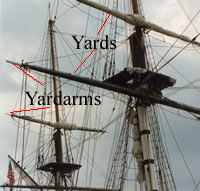
Yardarm & Omniglot
It was almost a year ago for Mixology Monday that I posted about the Main Brace tiki drink. The loveliness of the drink aside, the post contained a bit of history on the nautical significance of the mainbrace and its importance in historic drinking terminology.
A gent named Simon Ager over at the Omniglot blog explains a bit more about the relationship between booze and sea vessel anatomy with the yardarm. Simon's websites Omniglot and Omniglot blog are rich online resources for anyone interested in language(s), and I highly recommend them. Check out his post here.
Thursday, October 11, 2012
MxMo LXVI: (It Ain't Easy) Bein' Green
This month's Mixology Monday theme is "Bein' Green", and it's hosted by the Wordsmithing Pantagruel. The rules of the theme are cocktails whose ingredients concern anything that is the color green. I've been known to use MxMo themes a bit liberally, but not this time...
There just aren't enough savory drinks, am I right? Aside from the Bloody Mary, the savoriness of too many drinks are defined simply by their garnish.
This drink is an original of mine which I've been working on for about a year now, but it didn't start out as savory. I originally sought to combine rye whiskey, celery bitters, and honey syrup... and so, of course, I used all three to make an Old Fashioned. It didn't really work, and so after much trial and error (hiccup), the Tee Ball cocktail is what we have here today.
As for rye whiskeys, my new favorite is Knob Creek Rye. It's spicier and more heavy on grain than most of them out there, and it's a real joy in the glass.
I suppose I have 3 ingredients that qualify for this week's MxMo theme.
ORIGINAL REMIX
Tee Ball
2 oz rye whiskey
.5 oz green Chartreuse
.5 oz dry vermouth
1 dash celery bitters
Stir with ice and strain into a cocktail glass. Garnish with an olive, or, should you appease the cocktail onion gods, an onion.
There just aren't enough savory drinks, am I right? Aside from the Bloody Mary, the savoriness of too many drinks are defined simply by their garnish.
This drink is an original of mine which I've been working on for about a year now, but it didn't start out as savory. I originally sought to combine rye whiskey, celery bitters, and honey syrup... and so, of course, I used all three to make an Old Fashioned. It didn't really work, and so after much trial and error (hiccup), the Tee Ball cocktail is what we have here today.
As for rye whiskeys, my new favorite is Knob Creek Rye. It's spicier and more heavy on grain than most of them out there, and it's a real joy in the glass.
I suppose I have 3 ingredients that qualify for this week's MxMo theme.
ORIGINAL REMIX
Tee Ball
2 oz rye whiskey
.5 oz green Chartreuse
.5 oz dry vermouth
1 dash celery bitters
Stir with ice and strain into a cocktail glass. Garnish with an olive, or, should you appease the cocktail onion gods, an onion.
Labels:
mixology monday,
original remix,
recipes,
whiskey
Thursday, September 13, 2012
MxMo LXV: Equal Parts
Thank god that Frederic of Cocktail
The theme for this MxMo is Equal Parts: any cocktail whose ingredients are called for with equal parts, not including garnish, and maybe a dash of bitters, if you're being liberal. I'm going to be extra liberal and call for 2 dashes of bitters and yet still qualify for the theme.
My entry is as simple as it is sacrilegious: the Saratoga cocktail. What's the sacriledge? That this Manhattan variation is better than the Manhattan. That's it.
I was turned on to the Saratoga originally by an interview with Camper English conducted by the 12 Bottle Bar. (Question # 6)
The Saratoga is simply a rye Manhattan, half of whose spirit is replaced with brandy. It is my opinion that this combination elevates the Saratoga into a realm of interest and complexity which surpasses both rye and bourbon Manhattans.
As per my suggestion, Rowen of the Fogged In Lounge mixed up a Saratoga to stack up with the slew of other Manhattans that he was comparing recently, and he half agrees with me, at the very least.
Though recipes vary little, my Saratoga recipe comes from 12 Bottle Bar, which comes from David Wondrich. You owe it to yourself to make this drink, if you haven't, simply so you can strike down my preposterous claim above.
Saratoga
.75 oz rye whiskey
.75 oz brandy
.75 oz sweet vermouth
2 dashes Angostura aromatic bitters
Stir with ice and strain into a cocktail glass. Garnish with half a lemon wheel.
Labels:
cocktail,
mixology monday,
recipes,
rye,
whiskey
Saturday, September 8, 2012
Obsessives
Our first obsessive today is Rowen of the Fogged In Lounge. Far from the first time writing about the Manhattan cocktail on his site, this time Rowen's decided to ask his followers how they like to make their Manhattans. In an exploration of the very subtle ways Manhattans can vary and also his peers' specific tastes, he's been mixing up each iteration and posting about them.
Just recently he reviewed the preferred Manhattan of yours truly. Read it here. His short description of its flavor proves to me that it turned out exactly as it should have.
Our second obsessive today is Dagreb. Dagreb has an unhealthy(or perhaps, healthy) obsession with Angostura bitters. I first got a taste of this (literally) when he issued his monster of a drink to my own hosted Mixology Monday, where Dagreb taught me that the number of dashes of bitters after which I begin to question myself is twelve.
Dagreb's latest move is one that I would almost certainly call satire, were I not familiar with Dagreb and his tastes. Today Dagreb has taught me another thing: that the difference between potable and non-potable bitters means nothing. Rifling through the internet's tributes to Angostura bitters, Dagreb finally drops the bomb by presenting an Old Fashioned that's anything but old fashioned... with the Angostura Bitters Old Fashioned. After repeatedly calling him crazy and cursing his name, you may ask yourself, "What kind of bitters do you add to an Old Fashioned made of bitters?" You'll have to click and find out.
Saturday, August 25, 2012
The Few Vodka Drinks I Think Are Worth Drinking
Summer is waning but the heat is only barely letting up. Don't underestimate the ability of a good vodka drink to cool you off.
Many people think that vodka is made from potatoes or grain, but the truth is that vodka can be made from any source material. Traditional sources tend to be potatoes, barley, and wheat, but other sources can be (and sometimes are) things like rye, sweet potatoes, cane/molasses, beets, and fruits like grapes and apples.
What defines vodka is this: whatever fermented source mash present is distilled to a high enough percentage alcohol (removing enough impurities) in order to achieve a clean, subtle flavor. Put another way: vodka's lack of flavor is (traditionally) what defines it. The process to make vodka removes so much flavor that it doesn't matter whether you begin with grape juice, malt wort, or molasses.
Many new age vodkas go about distilling more lightly in order to keep natural flavors, but the vast majority of traditional vodkas aim to eliminate flavor, not keep it. This is why it's recognized that the many vodkas' flavor comes most from the water used to dilute the distillate.
Does this mean that vodka has no value and should never be used in drinks? Not exactly.
Vodka has the ability to enhance the flavors of simple cocktails, and sometimes even alter them a bit to something that's a bit greater than the sum of its parts. And, depending on the vodka, you can also occasionally pick up some of the vodka's own characteristics in a drink.
As for vodka brands, there are a few widely acclaimed ones to which you should probably pay attention. Tito's Handmade vodka is one that comes to mind.

Another brand which is gaining popularity is Iceberg vodka, from Canada. The water for this vodka is acquired by the harvesting of icebergs that break off from Greenland and float to Newfoundland at a place called Iceberg Alley. Gimmick or not, the vodka is good. Its sweet on the tongue, and I can detect hints of citrus in it. This bottle was sent to me as a sample, but any follower of this site knows that I don't hesitate to point out faults with freebies, if any. I would recommend Iceberg to anyone.
Three drinks come to my mind when I think of tasty vodka cocktails.
The first is simply a Vodka Gimlet. You can read about the Gimlet here and my rant about Rose's Lime Juice here.
The second is the simple Vodka Cranberry, my favorite version of which is below, along with the legendary Moscow Mule.
Vodka Cranberry
1.5 oz vodka
4 oz cranberry cocktail*
1 wedge lime
Combine vodka and juice into a glass, squeeze lime wedge into glass and then toss it into the mixture. Add ice, and stir.
*Cranberry cocktail, the kind that has a plethora of other juices to sweeten it. If you try to go new age and use a fresh squeezed organic not-from-concentrate cranberry juice, the cocktail will be undrinkable.
Many people think that vodka is made from potatoes or grain, but the truth is that vodka can be made from any source material. Traditional sources tend to be potatoes, barley, and wheat, but other sources can be (and sometimes are) things like rye, sweet potatoes, cane/molasses, beets, and fruits like grapes and apples.
What defines vodka is this: whatever fermented source mash present is distilled to a high enough percentage alcohol (removing enough impurities) in order to achieve a clean, subtle flavor. Put another way: vodka's lack of flavor is (traditionally) what defines it. The process to make vodka removes so much flavor that it doesn't matter whether you begin with grape juice, malt wort, or molasses.
Many new age vodkas go about distilling more lightly in order to keep natural flavors, but the vast majority of traditional vodkas aim to eliminate flavor, not keep it. This is why it's recognized that the many vodkas' flavor comes most from the water used to dilute the distillate.
Does this mean that vodka has no value and should never be used in drinks? Not exactly.
Vodka has the ability to enhance the flavors of simple cocktails, and sometimes even alter them a bit to something that's a bit greater than the sum of its parts. And, depending on the vodka, you can also occasionally pick up some of the vodka's own characteristics in a drink.
As for vodka brands, there are a few widely acclaimed ones to which you should probably pay attention. Tito's Handmade vodka is one that comes to mind.

Another brand which is gaining popularity is Iceberg vodka, from Canada. The water for this vodka is acquired by the harvesting of icebergs that break off from Greenland and float to Newfoundland at a place called Iceberg Alley. Gimmick or not, the vodka is good. Its sweet on the tongue, and I can detect hints of citrus in it. This bottle was sent to me as a sample, but any follower of this site knows that I don't hesitate to point out faults with freebies, if any. I would recommend Iceberg to anyone.
Three drinks come to my mind when I think of tasty vodka cocktails.
The first is simply a Vodka Gimlet. You can read about the Gimlet here and my rant about Rose's Lime Juice here.
The second is the simple Vodka Cranberry, my favorite version of which is below, along with the legendary Moscow Mule.
Vodka Cranberry
1.5 oz vodka
4 oz cranberry cocktail*
1 wedge lime
Combine vodka and juice into a glass, squeeze lime wedge into glass and then toss it into the mixture. Add ice, and stir.
*Cranberry cocktail, the kind that has a plethora of other juices to sweeten it. If you try to go new age and use a fresh squeezed organic not-from-concentrate cranberry juice, the cocktail will be undrinkable.
2 oz vodka
1 oz lime juice
3-4 oz ginger beer
Build ingredients over ice and stir.
Wednesday, July 18, 2012
Cask: Culmination, and CocktailDB.com
Along with being able to search CocktailDB by drink names and ingredients, the site also offers up a curious tool: the Mixilator. Rowen of the Fogged In Lounge details a bit more about the Mixilator and his adventures with it here.
One of my pet peeves about CocktailDB is that it's bloated with mediocre recipes and recipe variations that are lost to time. While it's occasionally possible to find a diamond in this mixological rough, you'll find that more often it's just a collection of laughable or unremarkable blither.

Browsing recently, I got excited about and took a chance with a recipe that managed to use 3 ingredients that I had homemade myself in the past. Apple brandy? I have my own aged apple spirit. Gin? Why, I have my own attempt at slightly-aged "apple-twisted" gin still lying around! Plum brandy? While it may not be quite what is prescribed, I do still have my slightly sweetened umeshu, or Japanese plum wine(which is really more like a liqueur). Why, you could even conceive of creating the recipe's orange liqueur via my prescribed limoncello method!
Despite my self-aggrandizement, this is actually a really good, dry cocktail. I encourage you to make it at home. If you don't have the plum brandy, I imagine any dry fruit brandy or eau-de-vie would suffice. My only peeve with the thing is that it's a variation of another drink, so its history or pervasiveness is probably impossible to calculate.
Casino Cocktail Variation

1.5 oz gin
.5 oz apple brandy
.25 oz plum brandy
.25 oz sweet vermouth
1 dash Cointreau
Stir with ice, and strain into a cocktail glass. (Brandied cherry garnish optional, and my personal addition.)
Labels:
apple brandy,
cask,
cocktail,
gin,
recipes
Subscribe to:
Posts (Atom)