Showing posts with label infusion. Show all posts

Tuesday, September 15, 2015

Four Things I Learned Trying to Make My Own Gin

I spent this summer drinking gin.

I always say that rum is my favorite spirit, but I find myself recycling more gin bottles than anything else.  Whether this is because I'm unknowingly a gin fanatic or that gin cocktails are historically more prevalent than those of other spirits, I don't know.

As my palate explored the different styles and brands of gin and their subtle yet complex differences, I found my mind attempting to explore what other flavors could be added to a gin's recipe of botanicals and might still have success.

Wanting to experiment with this, instead of deciding to infuse upon some simple gin brand as a base, I flippantly decided that I would infuse my own gin, which I've seen done on the interwebs.  How hard could it be?  It turned out to be the hardest booze endeavor I've undertaken.  I haven't even dabbled with new flavors yet; I've spent all this time on getting a baseline gin.

Gin, of course, is most basically flavored vodka, in the sense that the base spirit can be of any fermented source, so long as it's distilled enough times to retain little flavor.  Proper gin, however, involves the infusion of herbs and spices either during distillation or before a final post-infusion distillation.

And so, half-assed gin can be made via infusion only.  I'm not one to half-ass things, but I am when it comes to not wanting to distill in my own house.  I realized that whatever gin I would be able to infuse would be not very similar to the real stuff, but I was hoping that I could get it "in the ballpark".  I bought a sensitive digital scale and everything!

After several months, I'm satisfied with my mix, though I still plan to improve it.  Here's what I've learned.


For infusing, there's juniper, and then there's juniper

Of course, juniper is the main flavorant in a gin's recipe across almost all the gin styles.  Dried juniper berries are easy to find.  I have a feeling that fresh berries would better, but I haven't sought to find them, as I imagine it would be difficult.

What surprised me is how different the resulting infusion is depending on whether you crush the berries or leave them whole and intact.  After weeks of confusing results, I realized that I obtained more of the traditional juniper flavor in my gin by leaving the berries whole instead of breaking their skin/shell by crushing.  So does this mean that main ingredient in most gin is actually juniper skin?  I still have no idea!


That traditional juniper hit is hard to achieve

As mentioned above, I didn't initially realize that juniper skin was important for the juniper flavor I was seeking (at least, in my trials).  However, I still haven't managed to achieve a central juniper note reminiscent of commercial gins.  I'm beginning to wonder if distillation is required for it.  Too much crushed juniper yields a bitter flavor that overtakes everything else, and too much whole juniper yields (surprisingly) a sweetness that doesn't jive with the rest of the flavors.  So for now I must settle with an amount of juniper that leaves that distinct flavor underwhelming in magnitude.


Humorously, my solution (for now) is to simulate the coniferous flavor using non-juniper means.  After infusing spruce needles with little success, I found a better alternative: pine needles!  I ordered food-grade pine needles online, and they play a role in my current recipe (alongside the juniper).  It's not quite the same as what I wanted, but it's good.


Angelica root makes a big difference

I'm not saying that angelica is needed in gin, because there are many commercial gins that do not use it.  But for me, angelica adds something that my recipe needed.  Its flavor (when infused) is astringent and bright; it adds a sourness that reminds me of wormwood (minus the bitterness) and a pungent acidity that is not unlike juniper, but perhaps more herbal and grassy.  I expected this root, by its looks, to be heavy and woody.  It turned out to be the opposite.  This makes me want to try to infuse orris root, which is also sometimes used in gin.


Infusion ratio/time is your flexible friend, but also your enemy

Think about all the different ways you could infuse an ingredient into vodka.  Obviously its strength would be dependent on how long the ingredient is soaked.  But, infusing an ingredient for, say, 2 hours is not the same as doubling the amount of ingredient for a 1-hour infusion, or halving it for a 4-hour infusion.  What about heating the vodka and then infusing?  What about infusing the vodka in the freezer?

Different flavor compounds within the same ingredient infuse at different rates and at different temperatures.  Have you heard of the recent craze in cold-brew coffee?  Cold-brew coffee tastes different than iced coffee.  Different flavor compounds brew out of the coffee grounds during a long, cold infusion as opposed to a short, hot one.


We haven't even talked about the difference between infusing ingredients whole, cracked, chopped, or ground.  Surface area matters.  And as with ingredients like the juniper above, since the skin and interior impart different flavors, the difference between infusing it whole and cracked, or cracked and crushed, can vastly change your results.

This freedom and flexibility soon becomes your enemy because of the vast variability that will always have you in trial and error.  Should your infusion take an hour or a week?  The ingredients being whole or ground to a powder/paste?  Which flavors will be compromised by either of these pairs of choices?  How much time and money are you willing to spend on perfecting this balance?


My recipe was designed minimize the amount of time and money it took to experiment.  I infused 8oz of vodka at a time(plus a little more), and I decided to have my infusion last 24 hours.  This allowed me to not go broke, and to make a different infusion every single day, if I so chose.

Here's what I have so far.  But as I said above, this endeavor, to its detriment, is a work in progress.


The DJ's Infused Gin (Homemade Mix)

8oz vodka
4oz vodka

1.5g juniper berries, whole
.75g lemon peel, sliced finely
.75g orange peel, slices finely
.5g pine needles, muddled
.5g canela cinnamon, torn
.4g juniper berries, crushed
.3g angelica root, cracked/crushed
cardamom*

Soak all ingredients in vodka for 24 hours, shaking vessel when able.  Strain, and dilute with 4oz more vodka.

* Cardamom is a tough customer.  It's in many gin recipes, but it's flavor is so strong that it's hard to wield.  I've experimented with whole and ground cardamom, and I still haven't yet found my perfect amount.  Err on the side of too little.

Thursday, June 21, 2012

Infusion #6: Limoncello

Summer's cosmically here, and you should sip some chilled limoncello to welcome it properly.

Limoncello is an Italian lemon liqueur which is prolific in Italy and, if you've been so fortunate to have visited the place, that would already be clear to you. Anecdotal evidence has told me that just about every serious meal in Italy is followed by a small chilled glass of limoncello, and it's almost offensive if you refuse it. It's generally served neat and chilled, though you can really take it any way you like it, and you can even mix with it.

The bad news is that limoncello, for some reason, isn't very easy to find in stores. The good news is that it is easy as hell to make. The better news is that once you've mastered making limoncello, you've unlocked an easy way to make tons of kinds of your own liqueurs at home.

Making your own limoncello follows a beautiful and modular process that's easily adapted:

Step 1) Fill a vessel (preferably glass... empty booze bottles work) with an amount of vodka.

Step 2) Place into the same vessel an amount of lemon zest.

Step 3) Let vessel sit for an amount of time.

Step 4) Strain the zest out of the vodka, and add some amount of sugar.

(All ingredient and time amounts are nebulous because it's all to taste. A higher and lower spirit/flavorant balance will require more or less time for a proper infusion, respectively.  You should at least be using about 1 lemon's worth of zest for each cup of vodka.  The infusion should probably sit undisturbed for at least a week before straining.)

As I've been quoted saying in articles before, this is a GIGO situation: infusing crappy vodka with lemon peels doesn't improve how the vodka tastes. You don't need to use Grey Goose, but a middle shelf alternative should be fine.

Tradition dictates your lemon zest should be completely devoid of pith, which is bitter. But if you like a bitter note to your limoncello, you won't hear me complain. You can avoid pith in a variety of ways. I like to peel the lemons with a vegetable peeler, and then use the flexible tip of a sharp knife to shave most of the pith off from the back (I'm not a perfectionist). But if you want no pith at all, I would say the easiest way is to use a micro-plane to zest the fruit very lightly. Whether your zest is in long wide strips or fine flecks, it doesn't matter.


After letting the mixture sit, strain out the solids using a coffee filter. To this infused spirit you can add sugar. Since sugar does not dissolve well in alcohol, you should firstly make a syrup by dissolving the sugar into water, and then add the syrup to the spirit. You can make a simple syrup or a rich simple syrup, depending on how much additional water you'd like to add to your spirit to sweeten it, thereby lowering its proof.


Once you add your sweetener, you're ready to drink.  Chilled in the freezer and served neat is traditional, but I'll take it any way.

What's a good limoncello cocktail?  I might first direct you to my own Southern Soprano...

The directions above are an easy guideline which you can use in more generic ways than it seems.  All you need is 1) a solvent, 2) a flavorant, and 3) a sweetener.  In the case of limoncello, those 3 variables end up looking like: vodka, lemon peel, and sugar

I'll leave you with a list of variations that I myself have tried with varying degrees of success, some of whose names are made up and some of whose are not...

Meyer limoncello: vodka, Meyer lemon peel, sugar
Limonmielo: vodka, lemon peel, honey
Limettacello: vodka, lime peel, sugar - my personal favorite
Pompelmocello: vodka, grapefruit peel, sugar
Pomelocello: vodka, pomelo peel, sugar
Uglicello: vodka, Uglifruit peel, sugar
Gimoncello: gin, lemon peel, sugar
Mojitocello: white rum, lime peel & mint, sugar

Monday, January 9, 2012

Infusion #5: Umeshu, Part II

Five months ago I let a few whole green pluots begin soaking in a bunch of soju. This was in a shoddy attempt to create my own version of umeshu, an East Asian plum "wine".

Because I'm on the other side of the earth, I settled for trying the recipe using an unripe version of some new-fangled cross-species instead of a traditional asian plum.

Much like seeing a movie before reading the book on which it was based, I can't tell you how faithful the final product is, but I can tell you how good it is.

It's good!


The infusion product ended up being a pale brown with almost a hue of green... ("before" and "after" pictured above) not bad considering that all this color was infused through the skin of the pluots.

The sweetness of the stuff is almost just right, between the initial sweetness of soju and the added sugar pulled from the fruit. Because of this, I only needed to add a bit of rich simple syrup in order to get it to my liking.

The final flavor is overwhelmingly of overripe plums... or even prunes, if you will. As someone who enjoys prune juice, I certainly enjoy this. A determined effort will reveal slight "green" flavors of sour plum and even perhaps the tannins that were once there. Sipping this umeshu certainly isn't a contemplative process where one strives to pick out flavors from a complex sip, but the process is, without a doubt, pleasant.

I would consider this umeshu infusion an overall success, though I have a feeling that my final brew is nothing like the real thing.

Friday, November 4, 2011

Infusion #6: A Food Network Monstrosity


I love television. A great deal of my time watching TV is centered on the Food Network. I love the cuisine and personalities on the Food Network, but I’ve learned to disrespect most of the alcoholic beverage recipes that I see on the channel. Most of them contain some sort of soft drink (Sandra Lee is running out of ways to mix vodka and lemon-lime soda) and the rest are usually sweetened beyond balance and into the realm of mass commercial appeal.

But a few weeks ago I found my face even more contorted in astonishment than usual while I was watching Claire Robinson’s “5 Ingredient Fix”. Her show is a pretty good one: each prepared dish contains only five ingredients, and I’m generally pleased by her recipes, though I feel she dumbs her techniques down a bit.

Anyway, Ms. Robinson was infusing vodka. Normally I wouldn’t pay much notice, but this time she was infusing with squash. The recipe is for “Spicy Pumpkin Vodka”. I decided that it was so crazy that I had to do it myself.


The recipe is simple: one infuses 3 cups of vodka with 2 cups of pumpkin or kabocha squash, 2 vanilla beans, a stick of (cassia) cinnamon, and 3 pieces of candied ginger.

To prepare the squash, you lightly roast it in order to purge a bit of moisture and to get the flesh sweet, then cut it into small chunks in order to increase the surface area for the infusion. I used pumpkin, as I could not find any kabocha squash.

This infusion calls for an infusing time of 3 days.

At the end of the infusion, I was quite surprised with the result. I thought that the thick, dense flesh of the pumpkin would impart very little flavor to the vodka, but I was very wrong.

While the nose of the stuff is vanilla and alcohol only, the sip offers something more intriguing. The warmness of the cinnamon and the sweetness of the pumpkin combine immediately with sharp spiciness of the ginger to create a flavor very much like gingerbread, a flavor I’ve seldom come across in the spirit world. The cinnamon comes back mid-palate with the vanilla rounding it out. The swallow brings vegetal pumpkin and ginger notes that border on maltiness as it goes down.


Ms. Robinson insists that you chill this vodka and consume as a shot, but I found that doing so dulls all of the flavor into mediocrity. Sipping this at room temperature is quite enjoyable, and I bet it'd be great if you put a half ounce or so into a Manhattan.

This is a good little recipe, but it's not cheap to make. Depending on how cheap you can find your pumpkin or your ginger, and especially using 2 whole vanilla beans for 3 cups of vodka, the end product's value isn't high. Also, the yielded infusion is even less liquid than you’d think, since the pumpkin does a good job of soaking quite a bit up. But it’s a fun experiment nonetheless. Go out and make some now, just in time for Thanksgiving and Christmas parties. You can still find pumpkins and kabocha in the markets – I promise.

Monday, August 22, 2011

Infusion #5: Umeshu, Part I

A small project I’ve been meaning to tackle for years now is the ability to make one’s own plum wine at home… more specifically, umeshu. Technically, umeshu isn’t a wine at all (though it’s called so), but in fact a liqueur.

Umeshu might be the simplest infusion yet done on this site, though its simplicity in preparation demands patience for the infusing. Umeshu is created by soaking whole green plums in soju.

Green plums aren't just unripe plums (though they can be). Because this is an east Asian recipe, what can be assumed required is one of several varieties of Korean plum, most of which ripen to a light green color. Their taste is sweet, though perhaps not as sweet as some of the darker species that you can find. I myself don't have direct access to unripe Asian plums, but what I did find recently in my local store was less-than-ripe green pluots. I know that they're not nearly the same as for what traditional umeshu calls, but I'm going for it.

Soju is a Korean spirit that you'll find more and more nowadays, if you make an effort. It's a mid-proof mostly neutral spirit that is traditionally made from rice, though modern versions can be made from grain and sweet potatoes as well. Most soju also has just a bit of sugar added at the end of production, so the result is a slightly sweet liquor that is about 40 proof (on average) and very subtle in flavor. By the way, soju is not to be confused (which it commonly is), with shochu or baijiu, their Japanese and Chinese counterparts which tend to be more commonly made from rice only and are also higher proof.

The method of infusion couldn't be simpler: wash the fruits and soak them whole in soju for at least a few months. This method concerns me a bit. From my limited experience with infusing whole fruits in liquor, I find that the flesh of the fruits, shielded from the alcohol directly by their in-tact skin, tend to decompose a bit from the inside out. Similar experiments of mine have resulted in ammoniated aromas from the mixtures. But every description I've read of umeshu insists that it's smooth and inviting, so perhaps my fears are unfounded.


I'm making a small batch divided into two jars. Traditional recipes have you include sugar to soak in the liquor with the plums, but I'll just add simple syrup to the final infused product, as I often do.

If any of you know why this experiment will fail or what I'm doing wrong, feel free to tell me. See you in a few months!

Tuesday, February 1, 2011

Infusion #4: Why I'll Never Buy Spiced Rum Again*

*Unless I want to specifically try a new brand.

Spiced rum holds a pretty ambivalent position in the minds of most people who are truly interested in spirits and cocktails. While it is a mainstay in most "nightlife" venues and bars, it is a relatively new kind of spirit which has few salient uses aside from mixing it in your favorite soft drink.

Worst of all, many spiced rum products aren't very good, anyway. Quite a few of them ride the same wave as trendy vodka which is driven more by marketing than quality, and it shows. A fine blogger by the name of Dr. Bamboo has done a detailed rundown of many spiced rums here, here, and here... I admit that he's a bit more generous with his scores than I would be.

Captain Morgan is the "Bacardi" of spiced rums, and it dominates the market. Sailor Jerry is a better product which has been gaining steam over the past few years. Foursquare is a premium spiced rum from Barbados which many rum fans love, but for some reason I can't bring myself to agree. If I were pressed to tell you any spiced rum brands worth buying, they would be Cruzan's new 9 (which the Drinkhacker quite likes) and Captain Morgan 100, which is a 100 proof version of the original... but it actually has a different and improved flavor.

Much like I said in my post about falernum, it turns out that spiced rum one can make at home is much better than anything you can buy. For this reason, I will no longer regularly buy spiced rum.

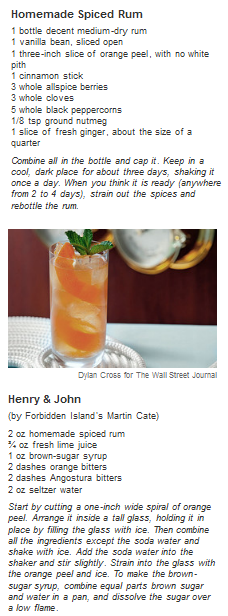
The recipe I use for spiced rum is very simple, and mostly inexpensive. The recipe comes from, of all places, the Wall Street Journal, detailed in an article here.

Spiced rum is an infusion, as simple as any other that I've made on this site. My last infusion was a compound infusion done in multiple stages. This recipe is also a compound infusion, but it's done in one stage.

The overwhelming flavor in most spiced rums is vanilla, and we achieve that by using a whole vanilla bean, the rarest and most expensive ingredient in this recipe. However, vanilla beans are now becoming easier to acquire via supermarkets; check your store's spice aisle... you'll probably be able to find a small jar with a few vanilla beans for less than $10.

There are various other spices in the recipe, and even some fruit. What is most important in this recipe is that you use whole and fresh ingredients, not their ground counterparts. The reason for this is so that you not only ensure that you have the freshest and highest quality ingredients possible, but also so that you can remove ingredients at will, should a single flavor become overpowering as you periodically taste the infusion.

Infusing doesn't make crappy rum taste better, so pick a good rum. A gold rum is standard, and usually one without too much overpowering character. For example, Cruzan Estate Dark is a fine choice, while Appleton Estate V/X may not be. Today I'm using my favorite gold rum, Cockspur Five Star. Cockspur is on the fruitier side of gold rums, and so I will be tweaking the original recipe slightly to take advantage of that.


Pictured here are the ingredients for my spiced rum. I've changed the slice of ginger with a peel of lemon, and I've throttled down the number of black peppercorns. Also, I've been known to put a peel of grapefruit in my spiced rum infusions... it goes great with the allspice. Before starting the infusion, I sliced open the vanilla bean, and I sawed off a chunk of the nutmeg with a bread knife.


Here's why you should use as whole ingredients as possible: 1 day into my infusion, I realized that my rum was going to be overpowered by allspice. I strained out the mixture (pictured below... pictured above is the plastic container I used for the infusion) and removed 2 of the 3 allspice berries before putting everything else back in the rum. When it was done, I learned that I had saved the infusion.


Homemade Spiced Rum
(adapted for the rum used & the DJ's tastes... click the image to the right to get the original recipe)

1 bottle bottle gold rum (Cockspur Five Star)
1 vanilla bean, sliced length-wise
1 three inch piece orange peel
1 three inch piece lemon peel
1 cinnamon stick
3 whole allspice berries
3 whole cloves
3 whole black peppercorns
1 quarter inch piece nutmeg

Combine all in container and seal. Let sit for 2-3 days. When desired flavor is reached, strain and re-bottle.

In order to whet your appetite on what a spiced rum drink can be, let us examine the recipe in the picture to the right. It is called the Henry & John, after (Captain) Henry Morgan and John Pemberton, the inventor of Coca-Cola. Call it a fancy "Cap'n & Coke", but it tastes nothing like it. This drink is created by Martin Cate, a modern day champion and authority on tiki drinks and bartending. Cate just opened up a new bar called Smuggler's Cove in San Francisco, a joint specifically designed to celebrate rum. And I must say, Henry & John is a drink on the order of some of the best rum drinks I've ever had.

Henry & John

2 oz (homemade) spiced rum
3/4 oz lime juice
1 oz brown sugar syrup*
2 dashes orange bitters
2 dashes aromatic bitters
2 oz seltzer water

Wrap a long piece of orange peel inside a tall glass, then fill the glass with ice. Shake all ingredients except the seltzer in a shaker with ice. Open the shaker, add the seltzer, then strain onto the ice in your glass with the orange peel.

*Recipe is in the image above.

Final note: be classy and save your prettiest booze bottles to house your finished infusion masterpieces.


Friday, January 21, 2011

Infusion #3: Winter Rum

I talk quite a bit about infusions on this blog. If you're tired of it, you're welcome to leave, but if you're not, then you're in for a treat, because I'm "turning it up a notch" today.

Over a year ago I decided to see what would happen when I infused fresh cranberries into white rum. The result, obviously, was cranberry rum, and while it achieved a beautiful red hue on the order of Campari, very little flavor was added to the final product except for a nice acidic tartness. I concluded that fresh cranberries would make a great infusion if used along with other ingredients. Today I'm finally running with that idea.

What I'm doing is what you could call a compound infusion, not simply because of how many ingredients I'll be using, but because of how I will be doing it. When I talked about making bitters a while back, I spoke of a conservative method of infusion whereby one infuses alcohols separately and then combines them into a perfect blend via trial and error. Today, I'm using a different technique with the same soul: instead of infusing all the ingredients at once, I will be doing it in stages. With this method, I can halt each infusion handily at the moment when its flavor is perfect, and then continue with the next so as to best balance the combination of tastes in the final product.

I'm going with three infusions this time: dried berries, fresh cranberries, and cinnamon, and I'll be doing it with rum. Why rum again? Because it's what I know best and because it's so versatile. I promise to do a non-rum infusion soon.

I've used Cruzan Estate Light in several infusions, and I'm using Cruzan again this time, but I will be using their Cruzan Estate Dark product. It's really more of a gold rum than a "dark" rum, but its flavor is dry and peppery as opposed to fruity and sweet, which makes it a perfect candidate for the base of a "winter rum".


The first infusion was with the dried berries. I used all natural berries from Stoneridge Orchards, which is a combination of cherries, blueberries, cranberries, and raspberries. Infusing dried fruit into your liquor yields a very different result than fresh; the flavors are dark, earthy, and oxidized as opposed to bright and fruity. It also imparts more sweetness than usual. I put about a dozen berries in the bottle of rum, and less than 24 hours later, I decided it was already done, and strained them out.

Next up is the fresh cranberries. Like last time, I'll point out that you really need to rupture each berry so that the hollow inner surface area of the berry can add to the infusion.


About 15 crushed cranberries went in, and it was done about 36 hours later. Also like last time, the color of the rum has turned a beautiful red (pictured left), and there is now a tartness that balances out the sweetness imparted by the dried berries.

Lastly is the cinnamon (pictured right). Using a whole stick of cinnamon (and not the ground stuff) guarantees the cinnamon's quality and ease of extraction, and trust me when I say that shortly after being put into the rum, the stick unfurls and allows the liquor access to its whole surface area. As you can see, the berries so far have soaked up quite a bit of the rum that we won't get back. So sad!

The cinnamon only needed about 24 hours to impart what I wanted. The Winter Rum is complete (pictured left). The final result is interesting in that all of the infused components can be tasted individually in the rum. It has a very warming characteristic to it, which I suppose was what I was going for. The dried berries give an underlying sweetness, the cranberries lend a tartness that keeps the rum from being too boring, and the cinnamon applies an overall earthiness that really gives the rum its warmth. I'm satisfied with this experiment, though I would have wanted to infuse the dried berries for less time. For any of you trying something similar: go easy on the dried fruit.

You could use something like this in almost any application of spiced rum, or even in the stead of any gold rum to add a decidedly wintry spin on any cocktail. My application will be simpler.


Winter Rum & Ginger

2 oz Winter Rum
2.5 oz ginger ale or ginger beer
1 dash aromatic bitters

Combine ingredients over ice in a tumbler.

Next time you're at a bar where you don't trust the bartender, order a spiced rum and ginger ale; although cola is more traditional, I find that ginger ale better complements spiced rum, whereas I feel cola simply trounces it. Ginger ale is also well mixed with any old decent gold rum. Try it next time when you're out of ideas on what to make to drink.

This rum combines very well with ginger ale. The dried fruit flavors and cinnamon go especially well with the aromatic bitters. The concoction is pictured above in a beautiful gold-rimmed glass (of 4) that I found at an antique shop. The outsides (and insides) of the glasses are curiously adorned with miniature reproductions of pages and ads from old Montgomery Ward magazines.

Wednesday, November 10, 2010

Homemade Coffee Bitters

One of the things I try to do on this blog is not be redundant toward subjects that have already been touched upon by people smarter than I. For example, I began this blog with the beginning of my Cask series, an experiment with at-home spirit aging, something about which had been scarcely written. Also, the reviews on this site are of products for which there are scant reviews already. My original remixes tend to be fairly unorthodox, and not simply echoes of what you'll see in a book or another booze blog. Ultimately, I'm not going to pretend that I'm more clever than I really am, and so I choose only to write about things which might sound interesting coming from me in particular.

So, when I finally decided that it was time for me to try my hand at making my own bitters, I knew that I didn't want to simply start with the most-popular aromatic-type bitters. Aromatic bitters are typically made with a plethora of roots, spices, and herbs. Instead of simply finding some zany twist to some popular type of bitters, I instead sought to create a type of bitters that I always wished existed (or rather, wished was easier to obtain): coffee bitters.

How does one make bitters? Fairly simply: you infuse a bunch of crap in alcohol (not unlike some of my infusion experiments), but instead of stopping the infusion when the flavor is modest and palatable, you let it infuse for days, weeks, or months. And then sometimes, you remove the flavoring material, and infuse the alcohol again with more material. What you're going for is a result that is undrinkable, literally. In the end, what you want is something that is generally high in percentage of alcohol, overwhelmingly strong in flavor, and intensely bitter. Even though these attributes are usually negative, none of them are negative when you apply your finished product one dash at a time.

Someone who's been doing some pretty interesting stuff lately with bitters is CaptainMcBoozy. He's given me advice on making bitters, but I find that he and I stand separately on what appear to be two different schools on bitters fabrication. The Captain likes flying by the seat of his pants, throwing all his ingredients in one jar of alcohol, and infusing it until it's done. I myself am much more pessimistic about my chances of success, and so I subscribe to how Jamie Boudreau does it: infuse each flavor separately into its own tincture, and experiment with blending the tinctures in different proportions until you have it right. Otherwise, you greatly risk destroying your bitters; a pinch too much of any one ingredient can make it taste completely wrong.

Jacob Grier made some coffee bitters of his own, but my recipe took a very different flavor approach.

So for my coffee bitters, my process was fairly simple:

1) get 3 jars/bottles

2) put coffee grounds (I used Starbucks Summer Blend) in the first bottle, cinnamon sticks in the second bottle, and wormwood in the third bottle*

3) pour a mixture of vodka and grain alcohol in the bottles, enough to cover the contents completely

4) wait at least 2 weeks

5) strain each bottle (using a coffee filter, pictured right), and re-infuse them with new contents if you find that their flavor is not yet strong enough for your liking

6) store the tinctures separately, mix them in various combinations until you find one that tastes good (drunk with another spirit, not necessarily tasted alone)

7) mix more in those ideal proportions, and bottle it

Captain McBoozy recommends using Everclear as his solvent of choice. In order to save money, I use a mixture of vodka (80 proof) and grain alcohol (190 proof) that balances out to about 140 proof. A higher proof solvent with give you more "chemical surface area" (as I once read it so eloquently put) to capture the solute's flavors, and more specifically, its alcohol-soluble compounds. A simple vodka wouldn't do quite the same thing.


Where the hell do you get bitters bottles? Well, I don't know, really. The bitters-style cap that's meant for dashing is not something easily obtained. My solution is one that works fairly well: I go to www.specialitybottle.com, which is an absolutely fabulous site. There, you can buy just about any type of bottle you want(some of mine are pictured above). While they don't have dasher bottles, they do have dropper bottles and spray bottles, both of which, I find, apply bitters in an acceptable way (though you have to get a feel for how much to use using these new methods).


*Wormwood isn't easy to find. There are websites that sell herbs which you can order from, but I was lucky enough to find it in a local hispanic market. Trawl your local ethnic markets, and if they have an herb/spice/root section, be sure to look for it. It also may be useful to learn what your desired thing is called in a target language. I knew that wormwood was ajenjo in spanish, and I found it.


The coffee bitters ended up quite good. They ended up being a combination of tinctures of coffee, cinnamon, and wormwood, with a little vanilla extract in there as well. I could have tried to make my own vanilla tincture, but vanilla beans are very expensive, and I expect it would have cost me about 20 dollars to get any respectable amount of it infused.

The bitters taste most strongly of a burnt and smokey flavor, which let the moderate coffee flavor sit in back, fairly muted. The spiciness of the cinnamon works well with the smokiness, and the vanilla is there to soften everything. The wormwood provides little to no flavor, and instead serves to make everything more bitter, though this concoction is on the less-bitter side (compared to a commercial bitters). These bitters of mine may not actually be quite bitter enough. I'll just have to try harder next time.

What can these bitters do? Well, I find that these are best in a Scotch Old Fashioned(pictured above), for some reason. Perhaps the smokiness of the bitters plays well in scotch. The coffee bitters also go well in rum and rye whiskey. Both Rob Roys and rye Manhattans play nice with them.

I encourage you to try something like this. All you need is some high proof vodka, some spices/herbs/roots/whatever, some bottles, and some time! Combine your favorite flavors, and you can make your very own personal bitters!

Tuesday, May 11, 2010

Infusion #2: Strawberry Rum

You really have to feel sorry for strawberries. Much like limes, their flavor is one that very poorly translates into our modern world of processed foods and artificial flavors. Sure, you may enjoy those old strawberry candies or even that strawberry-kiwi drink from the soda machine, but those don't actually have a flavor like fresh strawberries. This is also mostly true of liqueurs and flavored liquors. Strawberry vodka is an abomination, as is the bottom shelf syrupy nonsense that you can sometimes find at your local liquor store. Long have I wanted an honest strawberry flavor in a spirit, and so that's what I set out to accomplish. It's quite easy, really.

A concoction that's been floating around for a while is the Tequila Por Mi Amante. It's basically a recipe for a strawberry-infused reposado tequila, and I've heard from several people that it's simply delicious. I chose to start there for my experiment, but used rum instead of tequila because, well, I know rum better than tequila, and frankly put, good rum is cheaper than good tequila.


I reached for the Cruzan Estate Light, like I always do. Its subtle but likable flavors are a good platform on which to build things. I poured about 500mL of the rum over top about 3/4 pint of fresh strawberries and 3/4 pint of organic frozen strawberries. (You just can't get sweet fresh ones in the spring here on the east coast.) I stored this mixture in small container and stashed it in the fridge, where I let it sit for a little over 3 weeks.


When I took it out and strained it, it was a tad bitter. I believe I should have removed the fruit earlier, but it still tasted good. I made a rich simple syrup and began to slowly add it to the rum in order to counterbalance the bitterness. Would it not have needed sugar if it infused for less time? I don't know, that's a question for another time.


In the end, I finished with a slightly sweet strawberry rum (not unlike the sweet flavored rums you can buy on the market) that actually tasted like it should, and has a beautiful almost-neon red color (though not as pretty as the cranberry rum). Its best application I found so far? In an aperitif glass over crushed ice with a lime wedge/twist.

Monday, January 11, 2010

Infusion #1 and Obscure Ingredient Commentary


Infusion #1

I like cheap fun. I like food too. Thus, I like infusing things in alcohol. It's yet another outlet in mixology where creativity can be loosed. Even if you don't have a lil barrel to age your own spirits at home, you can still transform something ordinary into something exciting, different, and personal. (Home-infused spirits make great gifts to friends.) This past fall (of 2009) I undertook a small infusion experiment with a fresh seasonal ingredient: cranberries. But honestly, you don't even need to use fresh ingredients... something like dried fruit will add a nutty and dark oxidized flavor to a spirit that fresh fruit couldn't begin to approach... anyone who's made their own brandied cherries from dried cherries to replace their store-bought maraschino cherries knows what I'm talking about.(I'm thinking of making a prune infusion at some point...) You're also not limited to fruit, either. Spices can also be a clever source of infusion, something which I'll talk about in the future on this blog. Hell, there are people who even infuse spirits with wood pieces in an attempt at faux-aging... Oh, and if you think you should only infuse vodka, you're wrong. We already have bacon-bourbon, strawberry tequila, and the list goes on.


I figured that fresh cranberries didn't have a strong enough flavor to sing the lead in a bottle of vodka, so instead I chose a light rum, Cruzan Estate Light, whose laurels on this blog I've already established. I thought that its light sweetness and vanilla and wood tones would go great with the flavor and tartness of the cranberries. Again, I knew that cranberries wouldn't provide much flavor. They really need to be cooked and sweetened for them to shine. You know how cranberry juice tastes so good with vodka? Well, that's not cranberry juice. It's a cocktail of ingredients in which cranberry concentrate is usually used, which has been cooked and then sweetened further.

Anyway, cranberries are hollow, which is why they so conveniently float when their vines are flooded with water for harvest. I decided to rupture each cranberry in the infusion so as to take advantage of all the interior surface area. All you do is pinch the cranberry between your fingers, and the ensuing pop is quite satisfying. Fresh cranberries are also nice to eat, in my opinion. They're tart and fresh tasting, with very subtle vegetal flavors... they are quite acidic, however, so I'm not sure it's a great idea to have them replace your bowl of popcorn when you sit down for movie night.


The busted berries fit conveniently into the mouth of the temporarily-emptied Cruzan bottle. I dropped about 1 cup's worth of them into the bottle, and filled her back up with rum. The infusion only took a few days, as most infusions do. The lightly-tanned Cruzan turned pink, and then redder, and finally an absolutely beautiful hue of red that would rival most Red #4-pumped fruit punches on the market. Assuming it didn't taste awful, I knew that this method was worth the visual results alone. You should taste the infusion each day, and it's up to your taste when to evacuate the "infusor". Fruit sure does look pretty sometimes in that bottle, doesn't it? But if you don't take it out when it tastes good, it's going to start tasting bad. At 3 days, I decided it was time.


The taste? Well, I'm really glad I didn't use vodka, because the cranberries imparted little to no flavor. It did, however, lend a tartness to the rum that is pretty interesting. If one concentrates, perhaps one could discern a slight cranberry flavor, but nothing really worth mentioning. The tartness has virtually rendered the rum unsippable, so cocktails are its only final destination.

In what, you ask? One interesting concoction I made was a variation on the Gimlet on the rocks, one of my favorite cocktails. The cocktail consisted of 1oz gin, 1oz cranberry rum, 1 oz Rose's Lime Juice, and a dash of (real) grenadine to make sure it wasn't too tart, all poured over ice. The results were pleasant. You could really use an infused rum like this in any drink that calls for light rum, but motions should be taken with the recipe to ensure that the sweetness of the drink is not thrown out of balance.


So, what did I learn from my first infusion experiment?

1) Cranberry infusions result in a brilliant color that could be useful and pleasing along with other infusions
2) Cranberry infusions don't provide much flavor, but do provide a tartness that could be useful and pleasing along with other infusions

So I think that settles it. Cranberries will definitely be used in my future infusion experiments, but not alone.


Why I'm not "posting" the above drink recipe on this blog

(Occasionally I will write commentary on mixology and the blogosphere. The following is classified as such.)


And now, an entreaty to bloggers everywhere. Please don't go overboard on posting recipes that require ingredients which are so specialized that no one will make them. Hyperbolic example:


Teh DJ HawaiianCocktail

1 oz light rum
2 oz gold rum
.5 oz lime juice
.25 oz grenadine
1.5 oz orange juice
.25 oz DJ HawaiianShirt's Saffron and Starfruit syrup

Shake with ice and pour into tiki mug. C'mon guys you really need to try this drink! But you gotta make sure you use the best and freshest saffron and starfuit, ok??


Of course I'm being a little facetious here, but things like this need to be kept to a minimum, unless you're explicitly professing to make wacky homemade ingredients and cocktails containing them, at which point readers who are looking for recipes they can easily make at home can simply shy away, if they choose. Not too many blogs commit this over-use of homemade ingredients, but some are certainly worse than others. (no names) Even if you provide the recipe for the unique ingredient, that doesn't mean it's not irritating when you use too many of them. Used sparingly, it's ok... but please, show some self control. And so, since I do my best to(most of the time) post drinks that are accessible* and sane,
I will not mark the above Gimlet variation as a drink that will come up on this blog or the internet if someone is actively looking for drink recipes that they could/should make. Not to mention that I'm not sure if that variation is good enough to post, anyway.

*"Accessibility" is a dangerous word for home mixology. There's no way around the fact that an enormous amount of different ingredients are needed for one to be capably equipped to mix any decent amount of recipes that you'll find.


Especially, ESPECIALLY if you are participating in a Thursday Drink Night(TDN) celebration (a weekly event where bloggers and cocktail fans alike join in a chatroom to create their own drink recipes centered around a given theme and to have said drinks mixed on the spot by those who are able in order to provide instant feedback), where inclusiveness and unity are literally the goal of the event, try your best not to post a recipe that contains a home-made ingredient, or even a hard-to-find ingredient, for that matter. If none or only one or two people at a TDN can make the drink you're posting, then why post it? Choose something else so that more people can partake. If you'd rather post a monologue of exclusive recipes, blog it instead.