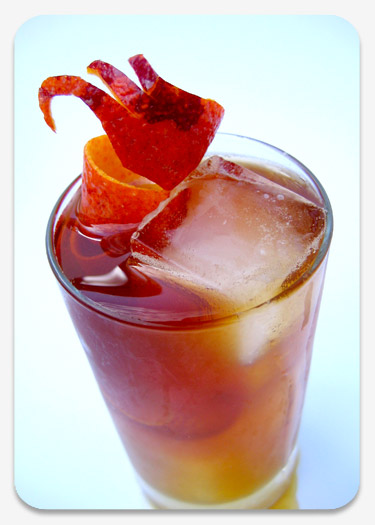
This month's Mixology Monday theme is "Bein' Green", and it's hosted by the Wordsmithing Pantagruel. The rules of the theme are cocktails whose ingredients concern anything that is the color green. I've been known to use MxMo themes a bit liberally, but not this time...
There just aren't enough savory drinks, am I right? Aside from the
Bloody Mary, the savoriness of too many drinks are defined simply by their
garnish.
This drink is an original of mine which I've been
working on for about a year now, but it didn't start out as savory. I
originally sought to combine rye whiskey, celery bitters, and honey
syrup... and so, of course, I used all three to make an Old Fashioned.
It didn't really work, and so after much trial and error (hiccup), the
Tee Ball cocktail is what we have here today.
As for rye whiskeys, my new favorite is Knob Creek Rye. It's spicier and more heavy on grain than most of them out there, and it's a real joy in the glass.
I suppose I have 3 ingredients that qualify for this week's MxMo theme.
ORIGINAL REMIX
Tee Ball
2 oz rye whiskey
.5 oz green Chartreuse
.5 oz dry vermouth
1 dash celery bitters
Stir with ice and strain into a cocktail glass. Garnish with an olive, or, should you appease the cocktail onion gods, an onion.
Showing posts with label whiskey. Show all posts
Thursday, October 11, 2012
Thursday, September 13, 2012
MxMo LXV: Equal Parts
Thank god that Frederic of Cocktail
The theme for this MxMo is Equal Parts: any cocktail whose ingredients are called for with equal parts, not including garnish, and maybe a dash of bitters, if you're being liberal. I'm going to be extra liberal and call for 2 dashes of bitters and yet still qualify for the theme.
My entry is as simple as it is sacrilegious: the Saratoga cocktail. What's the sacriledge? That this Manhattan variation is better than the Manhattan. That's it.
I was turned on to the Saratoga originally by an interview with Camper English conducted by the 12 Bottle Bar. (Question # 6)
The Saratoga is simply a rye Manhattan, half of whose spirit is replaced with brandy. It is my opinion that this combination elevates the Saratoga into a realm of interest and complexity which surpasses both rye and bourbon Manhattans.
As per my suggestion, Rowen of the Fogged In Lounge mixed up a Saratoga to stack up with the slew of other Manhattans that he was comparing recently, and he half agrees with me, at the very least.
Though recipes vary little, my Saratoga recipe comes from 12 Bottle Bar, which comes from David Wondrich. You owe it to yourself to make this drink, if you haven't, simply so you can strike down my preposterous claim above.
Saratoga
.75 oz rye whiskey
.75 oz brandy
.75 oz sweet vermouth
2 dashes Angostura aromatic bitters
Stir with ice and strain into a cocktail glass. Garnish with half a lemon wheel.
Labels:
cocktail,
mixology monday,
recipes,
rye,
whiskey
Sunday, March 11, 2012
Egotistical Cocktails, Part 2
It's time for another egotistical cocktail, an original cocktail which you yourself have created that may not differ greatly from one or more already-established recipes, but one that you newly name anyway.
In response to my last one, Rowen of the Fogged In Lounge said this:
At first I didn't understand what he meant, but now I do. My understanding was deepened when I stumbled across an old post from Darcy O'Neil, one of the old guard booze bloggers. His post outlines some basic guidelines on when a new cocktail deserves a new name or not. Luckily, my creations fall within his guidelines, though I shall still call them egotistical.
This is one that I cooked up years ago accidentally while trying to use up a bottle of tonic water before the fizz ran out. Since that day, I've found myself making them more and more... it really might be one of the best drinks I've come up with.
Technically, this could be called a rye & tonic with lemon bitters, but instead I'll call it...
ORIGINAL REMIX
Danger
2 oz rye whiskey
3 oz tonic water
1 dash lemon bitters
Build over ice in an old fashioned glass. No garnish.
In response to my last one, Rowen of the Fogged In Lounge said this:
"There are variations [of the Improved Cocktail] that are more strikingly different than others. Had you used one of Cruzan’s milder rums, one might be more tempted to call it an Improved Santa Cruz Rum Cocktail. But Blackstrap is unusual enough that [the] interchangeable quality of the Improved template seems secondary [to the unique flavor of the rum]."
At first I didn't understand what he meant, but now I do. My understanding was deepened when I stumbled across an old post from Darcy O'Neil, one of the old guard booze bloggers. His post outlines some basic guidelines on when a new cocktail deserves a new name or not. Luckily, my creations fall within his guidelines, though I shall still call them egotistical.
This is one that I cooked up years ago accidentally while trying to use up a bottle of tonic water before the fizz ran out. Since that day, I've found myself making them more and more... it really might be one of the best drinks I've come up with.
Technically, this could be called a rye & tonic with lemon bitters, but instead I'll call it...
ORIGINAL REMIX
Danger

2 oz rye whiskey
3 oz tonic water
1 dash lemon bitters
Build over ice in an old fashioned glass. No garnish.
Labels:
cocktail,
original remix,
recipes,
rye,
whiskey
Thursday, December 30, 2010
Review: Woodchuck Winter & the Amber Stonewall
A popular alternative to beer in the United States is hard apple cider. Simply put, hard cider is beer that's been made with apple juice as a source of fermentation instead of beer's barley mash, but don't be fooled... cider isn't simply an alternative to beer, but a great drink in it's own right. (For a way to make a simple cider at home, check out my review of Spike Your Juice.)
As I understand it, cider is a much more popular drink in the UK than it is in the US. Truth be told, cider is rarely drunk by American beer drinkers as an alternative, but instead usually drunk by small cadres of cider fans. There are various kinds of cider around certain regions of the US, but Woodchuck is a brand that you’ll find almost nationwide. Luckily for us Americans, it’s a great brand, and they make great products.
Woodchuck's flagship is their Amber variety, a simple cider made from red apples. It's sweet and delicious. They make a Granny Smith cider, and one called 802 Dark & Dry, which is mixed with caramelized sugar. They also have Raspberry and Pear ciders, though consumer be warned: these are simply flavored apple ciders, not ciders of a different fruit.
Recently I learned that Woodchuck makes limited release seasonal ciders. While most websites pertaining to beer and spirits are dreadfully out-of-date when it comes to documenting their products, woodchuck.com is different. It tells me (albeit in marketing-speak) that they sell barrel-aged Winter, honeyed Spring, blueberry Summer, spiced Fall, and even Private Reserve Pumpkin cider!
But depending on where you live, they may be quite difficult to find. Even wine and beer authorities in my area such as Ace Beverage and Total Wine were unable to handily make a special order for me. But, for some reason, Harris Teeter has always had a superior Woodchuck selection, and that is where I haphazardly found a pack of Woodchuck Winter.
The Review
Woodchuck Winter
From the website:
"Somewhere between a delicate snowflake drifting down to your tongue and a hard-packed snowball to the teeth, the power of this winter Cider is a balanced culmination of Premium French and Traditional American Oak, giving the cider great complexity and broad characteristics that neither style could produce on its own."
I don't mean to give anything away, but I really had to compare side-by-side the Winter cider to Woodchuck's Amber cider in order to be able to discern some of the former's characteristics.
In the Glass
Like any cider, when poured into the glass, the Winter developed nowhere near the head that beer fans are used to. Once settled, the cider's color is a few shades darker than the Amber.
Smell
The smell of the Winter is delightfully apply, as expected, though its aroma is less powerful than the Amber.
Taste
This is the point where I realized that I needed to bring in the Amber cider for comparison and start over. The flavor of the Winter cider seemed undetectably different than the Amber, if perhaps a little less sweet. Disappointed, I cracked open some cold Amber and took a few sips. When I revisited the Winter, the differences finally arose.
The flavor is definitely less sweet, probably more on par with the Woodchuck 802 Dark & Dry. I finally taste the woodiness of the cider's extra aging... it's a very faint dry flavor much like the characteristics I taste in my own Cask-series spirits. I'm also able to detect a little bit of vanilla in the mix.
But alas, after a few sips, I can no longer taste the unique character of Winter. But when I switch back to Amber for a few sips and return to Winter once more, I can taste it again.
Conclusion
I guess I see what Woodchuck is doing here. They make a varietal of their cider whose flavor doesn't appreciably stray from their "core" ciders. That way, their loyal fans are able to drink their varietals without having to adapt their tastes or think too hard. But when someone like myself can barely taste the difference between your core and varietal ciders, then you have a problem.
I dearly wish that beverage and spirit companies would take more chances in issuing unique variations of their products. It really comes down to money versus innovation: you can either ensure that a new product is close enough to the old to keep consumption the same on average, or you can take a leap that may fall on its ass, but it may also advance the industry.
Perhaps I'm being a little harsh or hyperbolic, but I'm quite disappointed with Woodchuck Winter. I wouldn't go out of my way again to obtain it. I'd buy it again only to impress my cider-drinking friends at a party. I'd recommend it only to those who could obtain it easily. As for the other Woodchuck limited releases, I'd still love to try them, but knowing how nebulous it is to get my hands on them, I don't know if I ever will.
While we're on the subject of cider, let me share with you a great drink: the Stonewall cocktail.
You won't find too much information on the Stonewall for some reason, but some quick research makes it clear that the drink consists of whiskey and apple cider, hot or cold. I've found that Woodchuck Amber and bourbon make a fine Stonewall, and its flavors really hit the spot in fall or winter, for whatever reason. The bourbon manages to bring out the yeastiness of the cider, and the cider manages to highlight the pungent corn flavors of the bourbon. Do yourself a favor and pick up a pack of Woodchuck for this year's New Year celebration, and do yourself a second favor by making an Amber Stonewall.
Amber Stonewall
2oz Woodchuck Amber hard cider
1oz bourbon
Pour ingredients into a tumbler filled with ice. Optional cinnamon stick for a stirrer/garnish.
As I understand it, cider is a much more popular drink in the UK than it is in the US. Truth be told, cider is rarely drunk by American beer drinkers as an alternative, but instead usually drunk by small cadres of cider fans. There are various kinds of cider around certain regions of the US, but Woodchuck is a brand that you’ll find almost nationwide. Luckily for us Americans, it’s a great brand, and they make great products.
Woodchuck's flagship is their Amber variety, a simple cider made from red apples. It's sweet and delicious. They make a Granny Smith cider, and one called 802 Dark & Dry, which is mixed with caramelized sugar. They also have Raspberry and Pear ciders, though consumer be warned: these are simply flavored apple ciders, not ciders of a different fruit.
Recently I learned that Woodchuck makes limited release seasonal ciders. While most websites pertaining to beer and spirits are dreadfully out-of-date when it comes to documenting their products, woodchuck.com is different. It tells me (albeit in marketing-speak) that they sell barrel-aged Winter, honeyed Spring, blueberry Summer, spiced Fall, and even Private Reserve Pumpkin cider!But depending on where you live, they may be quite difficult to find. Even wine and beer authorities in my area such as Ace Beverage and Total Wine were unable to handily make a special order for me. But, for some reason, Harris Teeter has always had a superior Woodchuck selection, and that is where I haphazardly found a pack of Woodchuck Winter.
The Review
Woodchuck Winter
From the website:
"Somewhere between a delicate snowflake drifting down to your tongue and a hard-packed snowball to the teeth, the power of this winter Cider is a balanced culmination of Premium French and Traditional American Oak, giving the cider great complexity and broad characteristics that neither style could produce on its own."
I don't mean to give anything away, but I really had to compare side-by-side the Winter cider to Woodchuck's Amber cider in order to be able to discern some of the former's characteristics.
In the Glass
Like any cider, when poured into the glass, the Winter developed nowhere near the head that beer fans are used to. Once settled, the cider's color is a few shades darker than the Amber.
Smell
The smell of the Winter is delightfully apply, as expected, though its aroma is less powerful than the Amber.
Taste
This is the point where I realized that I needed to bring in the Amber cider for comparison and start over. The flavor of the Winter cider seemed undetectably different than the Amber, if perhaps a little less sweet. Disappointed, I cracked open some cold Amber and took a few sips. When I revisited the Winter, the differences finally arose.
The flavor is definitely less sweet, probably more on par with the Woodchuck 802 Dark & Dry. I finally taste the woodiness of the cider's extra aging... it's a very faint dry flavor much like the characteristics I taste in my own Cask-series spirits. I'm also able to detect a little bit of vanilla in the mix.
But alas, after a few sips, I can no longer taste the unique character of Winter. But when I switch back to Amber for a few sips and return to Winter once more, I can taste it again.
Conclusion
I guess I see what Woodchuck is doing here. They make a varietal of their cider whose flavor doesn't appreciably stray from their "core" ciders. That way, their loyal fans are able to drink their varietals without having to adapt their tastes or think too hard. But when someone like myself can barely taste the difference between your core and varietal ciders, then you have a problem.
I dearly wish that beverage and spirit companies would take more chances in issuing unique variations of their products. It really comes down to money versus innovation: you can either ensure that a new product is close enough to the old to keep consumption the same on average, or you can take a leap that may fall on its ass, but it may also advance the industry.
Perhaps I'm being a little harsh or hyperbolic, but I'm quite disappointed with Woodchuck Winter. I wouldn't go out of my way again to obtain it. I'd buy it again only to impress my cider-drinking friends at a party. I'd recommend it only to those who could obtain it easily. As for the other Woodchuck limited releases, I'd still love to try them, but knowing how nebulous it is to get my hands on them, I don't know if I ever will.
While we're on the subject of cider, let me share with you a great drink: the Stonewall cocktail.
You won't find too much information on the Stonewall for some reason, but some quick research makes it clear that the drink consists of whiskey and apple cider, hot or cold. I've found that Woodchuck Amber and bourbon make a fine Stonewall, and its flavors really hit the spot in fall or winter, for whatever reason. The bourbon manages to bring out the yeastiness of the cider, and the cider manages to highlight the pungent corn flavors of the bourbon. Do yourself a favor and pick up a pack of Woodchuck for this year's New Year celebration, and do yourself a second favor by making an Amber Stonewall.
Amber Stonewall

2oz Woodchuck Amber hard cider
1oz bourbon
Pour ingredients into a tumbler filled with ice. Optional cinnamon stick for a stirrer/garnish.
Sunday, November 21, 2010
MxMo: Forgotten Cocktails
This month's Mixology Monday is hosted by Rock and Rye, and the theme is "Forgotten Cocktails". Contextually, Dennis of Rock And Rye is referring to cocktail recipes that may be of old age and, even better, underrated!

*Triple sec, if you must
**Try to use a sweet vermouth that isn't overpowering. I find that certain brands, such as Martini & Rossi, are veritable herbal assaults on the tongue, and just a bit too much. If your vermouth is too strong, it will upset the balance in the drink.

I have just the candidate, and as one of my favorite cocktails, I've been waiting to post it for quite a while.
The mythology behind the Oriental cocktail is that the recipe was loosed upon the world when an American engineer shared it with a Filipino doctor as repayment for his having saved his life from some tropical disease, as first mentioned in the Savoy. I personally find cocktail histories to be untrustworthy and dull, and so I'll stop here. Let's get on with the drinking.
1.5 oz rye whiskey
.75 oz orange curacao*
.75 oz sweet vermouth**
.5 oz lime juice
Shake all ingredients with ice, strain into a cocktail glass. No garnish.
.75 oz orange curacao*
.75 oz sweet vermouth**
.5 oz lime juice
Shake all ingredients with ice, strain into a cocktail glass. No garnish.
*Triple sec, if you must
**Try to use a sweet vermouth that isn't overpowering. I find that certain brands, such as Martini & Rossi, are veritable herbal assaults on the tongue, and just a bit too much. If your vermouth is too strong, it will upset the balance in the drink.
What separates this from many other obscure vintage cocktails is the flavor. Erik at the Underhill-Lounge remarks that it has a "very modern" taste, and he's right. As I've mentioned before, whiskey and lime is a fairly uncommon combination, which is what might lend to the drink's modern flavor. Furthermore, as Erik also points out, the amount of sweet and sour in the drink is high, such that the whiskey isn't exactly singing the lead.
It's the struggle between each ingredient in this recipe that makes it so interesting. Nothing is accenting and complementing the other here; instead, it's like a flavor free for all, where each is vying for your attention. It's an unusual dynamic for a cocktail, but it proves that it can be done, and in an entertaining way.
A variation on this recipe is the James Joyce which replaces the rye whiskey with Irish whiskey, constructed by the legendary Gary Regan.

James Joyce
1.5 oz Irish whiskey
.75 oz curacao/triple sec
.75 sweet vermouth
.5 oz lime juice
Shake all ingredients with ice, strain into a cocktail glass. Garnish with a maraschino cherry.
Chuck Taggart declares this drink to be superior and more complex than the Oriental, but I don't agree. (Probably because I used the balmy Jameson as my whiskey.) For me, this variation throws the Oriental's balance a little out of whack, as the subtler whiskey recedes to let the fruit and the sweetness take over. Regardless, it's still a fascinating drink, but in a different way.
Lastly, I have my own variation, which I daresay is my favorite version so far. One simply replaces the Oriental's rye with bourbon...
ORIGINAL REMIX

Sentimental
1.5 oz bourbon
.75 oz curacao
.75 oz sweet vermouth
.5 oz lime juice
Shake all ingredients with ice, strain into a cocktail glass. No garnish.
This drink tips the recipe's balance ever so slightly into the "sweet" direction, thanks to the bourbon, but I feel it's not too much. If you use something on the sweeter side, like Knobb Creek or Woodford Reserve, you'll find a deep spiciness appear in the drink causing you to praise whatever god you worship (or lack thereof).
It's the struggle between each ingredient in this recipe that makes it so interesting. Nothing is accenting and complementing the other here; instead, it's like a flavor free for all, where each is vying for your attention. It's an unusual dynamic for a cocktail, but it proves that it can be done, and in an entertaining way.
A variation on this recipe is the James Joyce which replaces the rye whiskey with Irish whiskey, constructed by the legendary Gary Regan.

James Joyce
1.5 oz Irish whiskey
.75 oz curacao/triple sec
.75 sweet vermouth
.5 oz lime juice
Shake all ingredients with ice, strain into a cocktail glass. Garnish with a maraschino cherry.
Chuck Taggart declares this drink to be superior and more complex than the Oriental, but I don't agree. (Probably because I used the balmy Jameson as my whiskey.) For me, this variation throws the Oriental's balance a little out of whack, as the subtler whiskey recedes to let the fruit and the sweetness take over. Regardless, it's still a fascinating drink, but in a different way.
Lastly, I have my own variation, which I daresay is my favorite version so far. One simply replaces the Oriental's rye with bourbon...
ORIGINAL REMIX

Sentimental
1.5 oz bourbon
.75 oz curacao
.75 oz sweet vermouth
.5 oz lime juice
Shake all ingredients with ice, strain into a cocktail glass. No garnish.
This drink tips the recipe's balance ever so slightly into the "sweet" direction, thanks to the bourbon, but I feel it's not too much. If you use something on the sweeter side, like Knobb Creek or Woodford Reserve, you'll find a deep spiciness appear in the drink causing you to praise whatever god you worship (or lack thereof).
Labels:
bourbon,
cocktail,
curacao,
lime,
liqueur,
mixology monday,
original remix,
recipes,
rye,
sweet vermouth,
whiskey
Thursday, November 4, 2010
Review: Evan Williams Honey Reserve
A while back I reviewed a new Seagram product called "7 Dark Honey", a whiskey liqueur that is flavored with honey. The product mostly missed the mark: its whiskey base was the underwhelming Seagram's 7, its aroma and flavor were dominated by alcohol, it tasted just as much of a generic (brown) sugar as it did honey, and its character was completely lost when mixed with anything else. This failure was particularly salient when compared to its competitor, Wild Turkey's American Honey liqueur. American Honey was bourbon based, and its honey flavor was prominent and enjoyable.Well, I spoke too soon. Shortly after the review(s), I stumbled across Evan Williams' entry into the product segment.
I'm a huge Evan Williams fan. For about $15, their normal black label bourbon is one of the best liquor values I know. The price makes you feel fine while mixing it away, but it's certainly refined enough to enjoy alone in a glass, which I do often.
The Review
Evan Williams Honey Reserve
Most of the Evan Williams bourbon flavor doesn't come through, despite its bourbon base, though if you pass up trying this product, you'll regret it severely.
In the Glass
I daresay that Honey Reserve is thicker than its competitors. Its viscosity is luxurious. But with that, its color is so light that you'd swear it uses a base other than whiskey.
Smell
The aroma of Honey Reserve immediately hits you, and it's fruity... mostly of lemon. Whereas the 7 Dark Honey's aroma is nonexistent and the American Honey smells faintly of bourbon, the Evan Williams immediately makes its aroma known. Aside from lemon, I'm detecting a brown sugar aroma, much like its competitors.
Taste
Strangely enough, the overwhelming flavor in this stuff is of fruit. It's got an overall fruitiness that is constant, and soon enough you realize that most of it is lemon. The sweetness coats your tongue, like this others; this one is mostly of honey, but there's some brown sugar in there too. After a while, you can begin to notice faint hints of vanilla, and even the sweetness of corn from the whiskey. The swallow brings more fruitiness and brown sugar.
Mixing
This stuff is heavenly over a few ice cubes... you'll find yourself struggling to stray from either doing that or mixing it with bourbon in various proportions. I think I successfully mixed this stuff into a Manhattan and it was good, but that was a long time ago. You can make it into an Old Fashioned by simply putting some bitters in it and throwing on a good twist of lemon.
Laced Straight
2 oz gin
.5 oz Evan Williams Honey Reserve
.5 oz dry vermouth
Stir with ice, and strain. Garnish with lemon twist.
This thing is great. The honey manages to keep the gin's botanicals in check, and there's a resulting nuttiness in the mix. It's sweeter than most clear gin drinks you'll ever have, which is a little disconcerting.
Conclusion
This is by far the best American honey whiskey product on the market. It takes a slightly different tack from its competitors by embracing a lemony fruitiness to accompany the wheat and the honey, but the risk paid off.
The moment I tasted Honey Reserve for the first time, I knew it was the best in its class. Weeks later, my suspicions were confirmed when I saw it behind the bar at the exceptional PS7 in Washington, DC.
Oh, and by the way, its price is smack dab in the middle of its two competitors. I'm not sure what more to tell you, other than to go buy some now.
Bonus: Here's what the Drink Hacker said about the stuff, and here is a piece done by Bourbon Blog on how one restaurant uses it to make a cocktail along with BBQ sauce.
Conclusion
This is by far the best American honey whiskey product on the market. It takes a slightly different tack from its competitors by embracing a lemony fruitiness to accompany the wheat and the honey, but the risk paid off.
The moment I tasted Honey Reserve for the first time, I knew it was the best in its class. Weeks later, my suspicions were confirmed when I saw it behind the bar at the exceptional PS7 in Washington, DC.
Oh, and by the way, its price is smack dab in the middle of its two competitors. I'm not sure what more to tell you, other than to go buy some now.
Bonus: Here's what the Drink Hacker said about the stuff, and here is a piece done by Bourbon Blog on how one restaurant uses it to make a cocktail along with BBQ sauce.
Labels:
bourbon,
cocktail,
dry vermouth,
gin,
honey,
liqueur,
recipes,
review,
value booze,
whiskey
Wednesday, August 25, 2010
MxMo: Brown, Bitter, and Stirred
This month's Mixology Monday event is themed after the blog hosting it: brown, bitter, and stirred.

As it just so happens, I have a recipe that I've been working on for quite a while that perfectly fits this theme. I've been waiting to post it, and so now seems like a great time.
As much as I'd love to be long-winded about this thing, there's really not much to say about it. You can really think of it as an elaborated Manhattan cocktail: you have two ounces of bourbon, you have dry vermouth and cherry brandy to replace the Manhattan's sweet vermouth, and you have Fernet Branca to replace the Manhattan's aromatic bitters. The final result tastes very much like a Manhattan, but just a bit more complex, herbal, and bitter.
Fernet Branca is a bitter liqueur from Italy called an amaro(amari, plural), one of many. It's made from a multitude of ingredients, and it's not for the faint of heart. For example, it's a go-to armament of mine when I win bets with friends, where the consequences involve shot-taking. Not only is Fernet Branca considered an amaro, it's also considered a potable bitters, meaning that it can serve as a digestif but also play the role of bitters in a cocktail. Campari is also in this category. A favorite anecdote of mine is that Fernet Branca can stain linoleum(it's as black as ink), and whoever said this isn't wrong; my last apartment has Fernet stains at various places on the kitchen counter.
Here is the MxMo roundup!

If you like this blog, please, PLEASE, try this drink (if you're able to make it) and post your comments below. I'm quite proud of this drink, and I'd love to know if anyone has opinions on it.
ORIGINAL REMIX
Old Knoxville
2 oz bourbon
.5 oz dry vermouth
.25 oz cherry brandy*
.25 oz Fernet Branca
Stir ingredients with ice, strain into cocktail glass. Garnish with maraschino cherry.
*Cherry Heering liqueur is the best choice here, but I prefer Hiram Walker's cherry brandy. If you use something other than Heering, double the amount. No, a clear cherry spirit/liqueur is not appropriate for this recipe.
Labels:
bitters,
bourbon,
Cherry Heering,
cocktail,
dry vermouth,
Fernet Branca,
mixology monday,
original remix,
recipes,
whiskey
Tuesday, January 26, 2010
Review: Seagram's 7 Dark Honey
Although my friends may call me a liquor snob, I'm really not. It's true that I do like nice things and do try to steer people in the direction of the top shelf as much as possible, but I of all people realize that our wallets can't always follow. Today we shall lower our eyes to the middle shelf of our hypothetical spirits-vending establishment and examine briefly the Seagram brand.

Seagram's brand of spirits is very much a hit and miss model. A look at their good products begins with their gin. Even though I find my palate for gins to be still evolving, Seagram's gin is not to be discounted. It is an American-style gin (as opposed to London Dry) which means that the tongue isn't assailed by the taste of Christmas trees (which I actually like), though American-style gins vary widely in flavor. Seagram's gin's claim to fame is that it is one of the only gins to be lightly aged in barrels while almost all others are un-aged. The resulting taste is one similar to a London Dry, but much more mellow with slight flavors of oak... it makes a killer Gimlet. As an admitted non-expert on vodka, I can also say that Seagram's Vodka is also a great buy for the price. They both have really great bottles too.
Seagram's Smooth Brazilian Rum is a newly-launched product, and as a drinker much more versed in rum than other spirits, I have to say that it's simply a fine product. It's a rum produced from sugar cane juice instead of molasses, in the style of Rhum Agricole and Cachaca, such that its flavor is more on the caney and grassy side rather than a full-bodied and dry one. The Drink Hacker said this about the stuff: "This is actually drinkable on its own — when’s the last time you said that about a $12 rum?" The gin, vodka, and rum are all available for $15 dollars or (much) less, marking a considerable value for those looking to save a few bucks. As I've said before, being a liquor fan isn't cheap.
But Seagram's also markets products that don't really hit the mark. Notable are their Twisted Gins, which are basically some of the only flavored gins around, and they're just hard to take seriously. Also for sale is Seagram's "Gin & Juice", which are barely palatable syrupy concoctions that I can only assume are artificially colored and flavored (but I'm not positive). And lastly worth mentioning is Seagram's 7 Crown whiskey, which is an American blended whiskey (a dying breed) that's more often found on the bottom shelf than the middle. It's a long standing brand and even has its own cocktail, but it's really not a whiskey taken very seriously among whiskey-drinkers. In preparation for this post I did a quick tasting of the stuff at a local bar, and some notes I took down consisted of "alcoholy", "mellow", and "one-sided".
The Review
Seagram's 7 Dark Honey

I was interested to learn that Seagram's has a new product called Seagram's 7 Dark Honey which is a honey-flavored whiskey, and certainly not the first one on the market. This bottle was actually given to me for free to review, and so that's what I shall do. However, because this spirit clearly uses 7 Crown whiskey as a springboard, I really wasn't sure what to expect. For starters, the bottle is pretty cool, and is actually the same bottle used for Captain Morgan's Parrot Bay brand. This stuff is sweetened like a liqueur, and clocks in at 71 proof. (Not bad!)
It turns out that there's a mild controversy on the internet concerning how Seagram's may be promoting their products via marketers commenting on blog posts who pose as though they're normal readers, which can be read about here. I'll note that the person in question(according to that link) has also posted a comment on THIS blog several months ago, shortly before another person (the same one who sent me this product) commented, and both comments talked positively toward a brand name that I've never even uttered on this blog. When the Federal Government gets involved in this kind of stuff, you can imagine why I hold full disclosure in high esteem. With that said, I'm no less grateful or humbled to have received this gift; it's as if people think I know what the hell I'm talking about! But shall I be adding to this product's internet hype? No, I imagine I won't...
In the Glass
Nothing too groundbreaking here. It's the color of whiskey and is viscous like a liqueur.
Smell
Almost nothing but alcohol. I tried really hard, and I finally discerned a faint smell of wheat akin to the original 7 Crown whiskey. I'm also sensing a generic "sweet" smell... perhaps it's brown sugar, but it's definitely not honey. Near the end I detected something citrusy, which was a little strange.
Taste
Luckily, the first flavor I got was honey, but it was soon to be replaced with cinnamon, and then more alcohol. I tasted a fleeting wheat, much like the smell, before the alcohol burned my tongue a bit, and then the strong sweetness took over. To be honest, the mouth feel was quite nice. When it goes down the hatch, it's just fine, and finally flavors of brown sugar and cinnamon... and then more alcohol. Overall, despite all the alcohol burn, it's a pleasant experience. Perhaps disappointingly, its flavor is on the subtle side, much like it's mother, Seagram's 7 Crown. An added ice cube changed nothing of this experience.
Mixing
I set out to find a vehicle that could successfully deliver this stuff, and I did it alongside a fine young lady that (somehow) continually finds that I'm pleasant company. (DJ HawaiianSkirt, you could call her...) I knew we could do it. We tried some of the options that the official Seagram's literature suggested: as a chilled shot, on ice, with a little lime, and with cola. The shot tasted mostly of alcohol, and we found that so long as 7 Dark Honey is mixed with anything, its flavor is dominated and it "disappears" into the drink. (Seriously, when your product's flavor manages to hide in a small glass of seltzer, you know you have a problem.) Surprisingly, it works passably in a hot toddy (made with hot water, not tea) having the 7 Dark Honey replace both the whiskey and honey in the recipe. Also, the stuff isn't unpleasant on ice (but a lemon twist dashes its flavor) where it mysteriously has absolutely no aftertaste.
Conclusion
So, what's the final verdict? Well, I think 7 Dark Honey hits a little below Seagram's average mark. It's an overall pleasant liqueur, but its flavor is too subtle. It's nice on the rocks, but it is certain that your favorite mixer (unless it's flat water) will destroy what subtle character it has... otherwise, it's like using a sweet 71 proof vodka. You want a sweet honey liqueur that doesn't taste like whiskey? There's a better one that already exists, and it's called Barenjager. Perhaps this is a "gateway whiskey", perhaps it's a drama-free mixer (read: doesn't taste like booze), but whatever it is, it's not versatile, and not something for which I have much use.
Value (bonus section to the review!)
But here's the problem: I picked up a bottle of Wild Turkey American Honey, 7 Dark Honey's competitor. It's a bourbon-based liqueur, also honey-flavored, and also 71 proof(erie...). I had had the stuff before, but I bought more solely for this comparison. AH's smell blows Seagram's away... its aroma is bold, and actually of whiskey... and there's honey too, with a teasing herbal complexity. The taste is also of whiskey, and with a flavor of honey much more pronounced than Seagram's. The mouth feel is even better, the flavor more complex, even with hints of lemon at the swallow. And the punctuation to all this? Froogle says that AH is an average of $5-6 more expensive than 7DH. And so, simply, the final question is: Does Seagram's 7 Dark Honey have the best value among the whiskey-based honey liqueur products on the market today, or is it even worth your purchase? No.
Addendum: Evan Williams created a honey whiskey that's better than both the products by Seagram and Wild Turkey. My review of it can be found here.
Labels:
honey,
liqueur,
review,
value booze,
whiskey
Tuesday, December 1, 2009
Wasmund's Single Malt Review
The above picture isn't a publicity shot... it's a picture that my friend took behind Wasmund's distillery, where they have a small table and chairs
set next to the local stream.
The Whisky
Wasmund's Single Malt
Wasmund's Single Malt is the only whiskey in the United States that is malted and distilled under the same roof. The enterprise rests on the foothills of Appalachia in a small town called Sperryville in the Commonwealth of Virginia. The small distillery is run by a half dozen people, most of whom are family. They take local barley, malt it with local water, smoke-dry it with local fruitwood, mash it with more local water, distill it, age it in local barrels, and bottle-proof it with more local water. The whisky itself is usually less than a year old in age; the small barrels and fruitwood chips present in each barrel accelerate the maturation. The final product is a unique whiskey and does a fine job of turning professional heads. I'm sorry for the inconsistencies in spelling "whiskey". Rick Wasmund, classically trained in Scotland, insists the absence of the "e" when referring to his specific whisky. Thus, I will attempt to walk this tight rope.
In the Glass
Wasmund's whisky is of a color much more dark and red than your average whiskey, or even single malt. It's like some old Scot poured a glass from his favorite bottle and threw in a dash of coffee and red wine. It swirls readily and its legs are minimal; this is just too young of a whiskey to wow you with texture.
Smell
The first thing you notice is smoke, but instead of a slight peat smoke like that of Scotch, you get an assault of wood smoke on the nose, like walking into a restaurant that sells BBQ, or Wasmund's own distillery, for that matter. Continuing on, there's a warm presence of dried leaves, and an earthiness so earthy that it borders on dirt (in a good way). A long sniff reveals foundations of subdued malt/barley and dried apples(probably because of the applewood used to smoke the malt). Lastly, you finish with the hard-to-describe smell of fresh running water, often found near a stream or in a wet cave.
Taste
Much like your nose, your tongue will be overwhelmed with smoke. But this time you'll be able to discern the flavor of dried cherries in it(because the malt is also dried with cherrywood). Again, you'll notice flavors of dried leaves as well, which is my personal favorite. You'll taste more earthiness in a slight flavor of moss. Lastly, you'll find the maltiness, and finish with a sweetness that's not unlike the taste of marshmallows.
Conclusion
Wasmund's Single Malt is unlike any other whiskey, stylistically. Its sometimes-rough and thin mouth feel will confuse you when the incredibly complex flavors and aromas hit you, perhaps to its detriment. This is neither a whiskey with which to become inebriated nor something to hold in your hand as you socialize with friends or family at some party; it's to be drunk alone, in the quiet, in contemplation and concentration, where all of its flavors can be noticed and recognized. Drinking Wasmund's is like cracking open a textbook and learning something, then having your opinions challenged and again reinforced... it's a didactic and introspective experience. Although I have to say, making Wasmund's Old Fashioned doesn't hurt the whisky's character. At a price cheaper than most Scottish 12-year Single Malts, Wasmund's Single Malt is invaluable as a conversation piece and a study of spirits in general, and a bold statement on what an American single malt can be. Word has it that Wasmund's products are available in most of the eastern Midwest and mid-Atlantic East Coast, and their distribution is spreading. If your local store doesn't have it, they can probably order it.
With the review over, I'm going to add a few more points on why I think this product is so important to the culture of spirits today:
1) Innovation. Though Wasmund uses old methods that are tried and true for inspiration, his product mimics nothing. While its geography is American and its style is European, it does not taste remotely like either. Even better, the uniqueness of his product is not a gimmick. Brush your gaze across the vodka shelf in your local liquor store and you'll see plenty of recently-launched and soon-to-be-discontinued brands that were forged completely on a business model powered by brand marketing and not product quality. Wasmund's accolades and admittedly humble popularity come from the fact that he's making a product unlike any other, and a good one at that. In a land where Bacardi and Jim Beam dominate the industry... this is a breath of fresh air.
2) Local economy. I won't harp on this, because I myself tire of hearing it sometimes... Wasmund creates his products using completely local ingredients, which not only guarantees freshness, but displays a preference of quality over price; local ingredients aren't always the cheapest anymore, what with today's age of Walmart-style transportation networks. It also makes sense to help energize the economy around you and not one far away... after all, when everyone around you is living well, you probably will too.
3) Terroir. This is the most important, and a result of reason #2. Terroir is the effect that a landscape has on the taste of a food product. For instance, if a winery in France packed up and moved their personnel, equipment, and grape seeds to California to reestablish their enterprise in exactly the same way... their wine would taste different. Maybe not much, but it would taste different. The difference in soil composition, rainfall amounts, and even the chemistry of the air would impart slight variables that would ultimately change the character of the wine. Many people claim that the water in New York City is what makes the pizza there so delicious... I for one think that claim is a bit exaggerated, but nevertheless, it's still terroir. Wasmund's whisky is packed with terroir. Every single input ingredient in the process is strictly local... and by "local", I mean within about a 50 mile radius, if I'm not mistaken. Even though it might sound crazy, the taste of Wasmund's whisky transports me to the Appalachians in the fall, and I suppose that's no surprise. Their whisky doesn't let you forget where the product was made, and that's something exciting. The 2009 International Review of Spirits commented that Wasmund's "finishes with a very long, slowly evolving, mossy river stone, peat, cocoa, cereal, and pepper fade." So in the end, the word "earthy" manages to describe this products taste, ingredients, and process.
Wasmund's went on in the aforementioned contest to score 93 out of 100 points.
Labels:
copper fox,
distillery,
review,
single malt,
whiskey,
whisky
Monday, October 5, 2009
Brass Artillery and Boozy Gift Ideas
Last Thursday was Thursday Drink Night: Bourbon in the Mixoloseum Bar. I frequent the place from time to time, and I try to attend TDN whenever possible. The jist of TDN is that a bunch of cocktail fans gather 'round in a chatroom each Thursday and present to each other their own cocktail recipes based around a central theme. Last week's theme was bourbon, and so I thought that I might finally present a drink that I had been working on for a long time.
I began creating the drink after being inspired by the combination of lime and cinnamon syrup often used in tiki drinks. Then, I discovered that the unusual combination of whiskey and lime juice was also very successful, as in one of my favorite cocktails, the Oriental. I finally combined the two ideas and worked for months to perfect the proportions, and I ended up with the Brass Artillery.
I submitted the Brass Artillery for TDN Bourbon and received mostly good responses. A person in the chatroom named "chipotle" deemed its flavor as "tiki-ish", which is no surprise. Forrest called it "classic and focused", and suggested replacing the lime juice with a 50/50 mix of lemon and lime juice. Dr. Bamboo proclaimed that "the wife and myself give it a hearty 4 thumbs up!" Having more to say, he noted that the Brass Artillery tasted like a tiki drink shaken and strained into a cocktail glass, and eventually... "*expletive* lime and cinnamon are a good combo". I'll agree on both counts. Finally, with perhaps a bit too much liquor in him (I kid), he concluded "I'm thinking that the [Brass Artillery] should be served as one of those slushy, faux-daiquiris they sell in those Bourbon street places. and I mean that as a compliment." As hard as I try to imagine that as a compliment, I [again] very much empathize with the evocations of tropical drinks when sipping on the Brass Artillery. Overall, a very successful TDN for me and most everyone else. The recipe is waiting below.
ORIGINAL REMIX
Brass Artillery
2 oz bourbon
.75 oz lime juice
.5 oz cinnamon syrup
3 dashes aromatic bitters
Shake with ice and strain into a cocktail glass or a small rocks glass. Garnish with a lime wheel.
2 oz bourbon
.75 oz lime juice
.5 oz cinnamon syrup
3 dashes aromatic bitters
Shake with ice and strain into a cocktail glass or a small rocks glass. Garnish with a lime wheel.
I want to post two more cocktails from TDN Bourbon which I thought were superb. The first is from the aforementioned chap named chipotle, and the second is from Kaiser Penguin, one of the big wigs of the CSOWG and often the moderator of TDN. Rick from Kaiser Penguin is known for his photography, so I've posted a picture of his cocktail as well.
Controlled Burn
2 oz bourbon
2 tsp maple syrup
1tsp (smokey) scotch
2 dashes Fee's Whiskey Barrel bitters
Build on ice in a rocks glass. Garnish with an orange twist.

Archestratus' Cockscomb
2 oz bourbon
1 oz Fernet Branca
1 tps simple syrup
1 dash orange bitters
2 oz ginger beer*
Build on ice in a rocks glass. Garnish with an orange twist.
* KP said to "fill" with ginger beer, but I found that 2oz was perfect.
For the second half of this post, I will document the fabulous gift that I gave to one of my good friends recently for his birthday: premixed cocktail in a bottle! Well, bottles. Three of them to be exact... and one was a handle sized bottle.
You see, he's a fan of Long Island Iced Tea (snobs are allowed to snicker), but he never has all the ingredients to make it. So (with his prior permission, actually), I bought up a bunch of bottom-shelf bottles of liquor (not my proudest moment... my friend actually wanted the cheap stuff) and combined them accordingly along with some simple syrup into some bottles. The result is pictured below. All my buddy has to do now is mix a certain amount of the booze mix with some lemon juice and cola, and he's got his cocktail.

(I put mixing directions on the back of the bottle. Hey, shut up, those duct tape labels are of no lesser quality than the ingredients in the bottles...)
So the next time you have a loved-one's birthday coming up, think about mixing (the non-perishable) part of one of their favorite cocktails in a bottle for them! Cheers!
Labels:
bourbon,
cinnamon,
Fernet Branca,
original remix,
recipes,
tdn,
whiskey
Wednesday, August 26, 2009
Rum Punch Contest Entry
It's not often that I attempt to create a tiki drink. Why? Several reasons:
1) My attention span is barely long enough to acknowledge all the ingredients sometimes needed to make a good one.
2) Rum combinations are daunting.
3) Some of the best ingredients are obscure as hell.
4) The best ones have already been done.
I love rum and I love tiki drinks; they're actually what got me into cocktails. And some of the tiki drinks' complexities border on the most interesting things you've ever tasted. They merit you checking them out for yourself(in the links above) instead of ordering them in some restaurant.
But along comes Rumdood, who's hosting his own contest on who can make the best tiki drink, or more specifically, a rum punch. While rum punches may not specifically be tiki(the concept of tiki irritatingly clings to cultures and evocations of the Pacific while all of its ingredients come from the Caribbean), I essentially made it so with my ingredients. The prize for this contest is a free bottle of each product Mount Gay makes. I'm specifically excited about the Mount Gay XO, which is an exceptional rum, and Mount Gay Eclipse Silver, which is probably my favorite white rum. He's also giving away a bottle of his famed falernum, whose reputation precedes it. (But, as Dr. Bamboo has found, one should never give one's true opinion of it. Just smile and nod.)
I'm not allowed to make a recipe with specific products, which I'm disappointed about, so I'm going to do my best to not suggest brands for each ingredient. (Oh, and if you think bourbon isn't "tiki", shut up.) The general rule of rum punches is "One of Sour, Two of Sweet, Three of Strong, Four of Weak", which refers to the parts of the drink, and the proportions between the different parts. I stuck pretty close to this formula for my recipe, which I hope the Dood likes. It's very much the bastard child of the punch that your grandma used to make(you know, the one with the pineapple juice and ginger ale?) and the Champagne Cocktail.
Cheers!
ORIGINAL REMIX
Dragonfly Rum Punch
1 oz lime juice [the sour]
1 oz cinnamon syrup [the sweet]
.5 oz falernum [the sweet]
2 oz gold rum [the strong]
1 oz bourbon [the strong]
2 oz pineapple juice [the weak]
2 oz champagne or sparkling white wine [the weak]
2 dashes aromatic bitters
Shake all ingredients except the champagne with crushed ice. Pour everything into a tall collins glass. Pour in champagne, stir, and top with more crushed ice. Garnish tastefully, perhaps with a brandied cherry, lime wheel, or even a stick of sugar cane.
Monday, July 27, 2009
The Cask: Part 2

It's been about 2 months since I've put some of Wasmund's un-aged rye spirit into my little aging cask, which you can read about here.
According to heresay, the whiskey is about halfway done toward being appropriately aged. So of course, I'd like to monitor the spirit's progress. I turned the cask's nozzle to let loose some of the liquor. The color now is that of a gold rum, and perhaps about 2/3 as dark as I expect it will be in the end.
The smell of the spirit so far is still fairly strong... I imagine it's still fairly high above 80 proof, and will even stay so after a few more months; alcohol still wafts boldly from the cup. The aroma is mostly of smokey butterscotch, which is certainly not one that I've smelled on any whiskey before. Near the end, the slightest whiff of traditional rye whiskey comes through, finally.
The sip doesn't burn as much as it did when it was clear in color, about 2 months ago... now it's just warming, like a whiskey should be. My guess is that it's about 100 proof right now. As soon as it hits the tongue, there's a fleeting sweetness. The fullest flavor in the spirit is still that pungent rye which blooms on the tongue, and it's not without a touch of fruitiness, staying long after you swallow. Smoke again fills the throat once it's gone.
This would be quite an interesting spirit, if something like this were sold, but it's still a bit too fiery and bold, not unlike a tequila. I would indeed say that this stuff is halfway aged to something apropos, and perhaps a bit less than halfway toward perfection.... but that's a different post. :)
Cheers.
Sunday, June 7, 2009
Appalachian Single Malt at the Copper Fox Distillery
The Copper Fox Distillery is the home of Wasmund's Single Malt Whisky and Wasmund's Rye Whisky. Neighbor to Virginia's stunning Shenandoah National Park, the distillery rests just a dirt back-road or two from the center of Sperryville, a small charming place that looks just like an Appalachian foothill town should. The whole operation is housed by a wooden building that looks more like a barn than a distillery; only a small sign hanging above the large front doors (with miniature caged peeping door) indicates any enterprise.
Wasmund's intoxication begins with the smell as you walk into their distillery. The walls are imbued with fantastic smells of smoke and grain, and the look and feel of Copper Fox's main visitation area approach that of a dimly-lit Scottish tavern, not a place of industry. This, I imagine, is no surprise; the distillery is lead by a man named Rick Wasmund, a distiller who learned his craft in Scotland before returning across the pond to show us what an American single malt whisky can be. Wasmund is a warm and silly young man who is hard-pressed to take anything seriously except for his craft. His distillery tour is a back and forth of expertise and puns, innovation and anecdotes. His malting room sits near a suit of armor dubbed "Sir Malts-a-lot". Above his stored grain hangs a sign remarking the distance to Scotland's Loch Indaal. Wasmund's good humor reflects his dedication to loving what he does.
Wasmund's products are unique. They're not afraid to fly in the face of tradition in order to forge a new identity for American whiskey. Much tradition is still preserved, however, and the resulting balance yields a fascinating product via a fascinating process. Copper Fox is the only American distillery to malt themselves the same barley that they mash and distill. The barley, just like almost every component of Wasmund's, is locally procured. The barley is smoke-dried in the Scottish style, but say good-bye to peat smoke and hello to fruitwood smoke. Wasmund's barley is smoked only with apple wood and cherry wood from a nearby orchard. It is perhaps this step that imparts the most unique character to Wasmund's whisky.
Wasmund's mash is hydrated with water from deep beneath Sperryville. He remarks that the local water is uncharacteristically rich in calcium, imparting a sweet taste, and perfect for his fruity barley. The mash ferments and distills in a room no larger than a generous garage. Next to the stills is Wasmund's quaint proof-testing table, where he monitors and documents the distillate up to barrel proof for aging.
The aging takes place in American Oak barrels, all in small batches. The overall aging time is quite small, and this is because of Wasmund's chip barrels. He partly ages the whiskey with chips of the very same fruitwood used to smoke-dry the barley. The increased surface area of the chips added with the wood of the barrel produce a surprisingly mature spirit in a small amount of time. With that said, Wasmund's Single Malt, whose age is an average of 9 months, is delicious, yet its viscosity and smoothness won't fool you into thinking you're sipping an 18-year whisky. However, with a dash of water, like Rick Wasmund suggests, you'll find a flavor unlike any other.
Copper Fox is the embodiment of a micro-distillery. Every ingredient consumed is local. Age-old craft traditions are given a new twist. The end product is unique, worth a few extra dollars and a few more miles traveled. Wasmund jokes that not everyone should be able to drink his whisky, and he's ok with that. However, Wasmund's Single Malt can be found in a multitude of stores in the mid-Atlantic and midwest, and Copper Fox's arm of distribution is growing ever longer. If you're in Virginia, ask your store clerk if you're able to special order Wasmund's. You'll be glad you did.
Labels:
copper fox,
distillery,
single malt,
whiskey,
whisky
Tuesday, May 26, 2009
The Cask: Part 1

Behold. Wasmund's 2-liter aging barrel: one of the many exciting products being produced at Copper Fox Distillery in Sperryville, Virginia. Copper Fox sells at-home aging barrels of various sizes which tailor to different budgets, time constraints, and expertise.
What you see here is Copper Fox's smallest barrel. An average aging in this bad boy should take about only 4 months, and can be re-used several times (something of which I plan to take full advantage). One need only pour in about 2 bottles of (preferably barrel proof) spirit and let the aging begin.
Incidentally, my tastes mostly lean towards rum, and this barrel has the rum fan inside me going absolutely insane thinking about the possibilities. However, Copper Fox is best known not for their barrels, but for their whisk(e)y (Hereafter "whisky". Copper Fox prefers it). Wasmund's Single Malt Whisky (review coming soon) calls Copper Fox home and, along with their aged single malt and rye products, they also provide unaged whisky for the very purpose of at-home aging. How many (good) unaged whiskies do you know of? Exactly. This opportunity leaves me little choice but to christen my barrel with Wasmund's crystal-clear, overproof, Appalachian spirit.
Another consideration is that many rums are aged in barrels previously used for bourbon, and so, especially taking note of Wasmund's fruitwood smoke-drying process used for their single malt, I believe that it's completely appropriate to warm up the barrel with Wasmund's before the rum joins the party.

The Whisky
Wasmund's Rye Spirit, less than 30 days old
This endeavor begins with Wasmund's Rye Spirit, unaged. This product is quite interesting in and of itself. Each rye batch produced is truly a small one, with about only one barrel produced on each run. Their rye spirit mash consists of 2/3 rye straight from a local source, and 1/3 hand-malted barley that's been fruitwood-smoked. This is all offered at 124 proof for your aging convenience. I thought I would taste the spirit before I aged it.
Smell
It's hard to navigate though the evaporated alcohol as you inhale this one. After I began to concentrate, the most noticeable aroma is pungent, full-bodied, and grassy. It's not unpleasant, however. A further effort finally revealed a bit of smoke, as expected.
Taste
Damn, this stuff is strong. Ok... the smoke comes through much more here, which is quite nice. The sips are dry and short, no aftertaste. Finally come the first hints of rye, a bit spicy and warming. A few sips later, I begin to taste the malt. Even unaged, this is much more interesting than I anticipated. But really, this stuff needs some ice.
Ice cube:
Just a wee bit of ice and its character changes ever so slightly. Much more of the spiciness rises up and lasts longer. I even taste some floral hints as I breathe out. And finally, about a minute after each sip, I can taste apples, likely from the apple wood used to smoke the malted portion of spirit's source barley.
Conclusion:
A ridiculously interesting spirit for something so young. I can see why Copper Fox claims that many customers enjoy replacing various spirits in classic cocktails with this stuff, something I also plan to try. The spiciness and grassy character of this spirit beg to be played with. The only hurdle I can foresee is the proof, but if you're like me, you just don't care.
The Aging Begins

The spirit is poured and now time is my friend. I will drop quick samples of my aging product about every two weeks, and will post about any tastings of note or process revelations.
Questions and comments about my endeavor are welcome. Aloha.
Subscribe to:
Posts (Atom)