Showing posts with label review. Show all posts

Sunday, March 27, 2016

Review: Wicked Dolphin Silver Rum

As a spirit industry, rum has become more and more prolific over the last 10 years or so.  I recently tasted a new rum on the market that was made from white granulated sugar; distillers are quickly learning that you don't need to own a sugar cane field in the Caribbean in order to produce rum.  And yet, many rum producers outside of the Caribbean still import molasses from the islands.  Others purchase molasses from local cane producers.


Enter Wicked Dolphin, a rum distillery that's only a few years old, located in Florida.  Wicked Dolphin's rums are pot-distilled from the juice of cane cut from fields that are only minutes away from the distillery.  This marks one of the few American rum productions which sources fermentation material locally, in the tradition of more staid American spirit industries like whiskey and apple brandy.  The result is the beginning of an aspect to Wicked Dolphin's products that I wouldn't hesitate to call terroir.  The bottle that I have (batch #13!) was sent to me as a gift for review.

Nose

Despite the fact that Wicked Dolphin is distilled from cane juice, you wouldn't be able to tell by the nose.  The first few wafts have a sweetness and buttery-ness that will belie a molasses rum.  Along with butter, there's vanilla, light brown sugar, and gentle wood.  There's a freshness that I can only describe as running water.  A big whiff ends with a slight alcoholic spark that's pleasantly subdued.

Taste

The butter continues on the tongue.  The traditional white rum vanilla notes manifest here as butter and butterscotch.  The mouth feel has a noticeable viscosity.  Its sweet state on the tongue will once again make you think this is not cane rum.  It's at this time that the alcohol will remind you it's there on your tongue and the roof of your mouth.  The finish has a freshness that's reminiscent of the chlorophyll of crisp lettuce.  Perhaps that's the sugar cane's grassiness trying to come through?

Mixing

I find that because rums can vary so widely, so can their mixability.  The bottom of the scale grinds from the drown-it-in-cola stuff all the way up to the don't-you-dare-mix-that nectar of the gods.  My take is that Wicked Dolphin white falls somewhere between fruity drinks and drunk straight.  It plays perfectly in a Daiquiri or a subtle mixer like soda or ginger ale.

Conclusion

I've drunk too many shitty American rums.  The fact that Wicked Dolphin is imminently drinkable combined with its honest American end-to-end production make it quite noteworthy.  Some price checks will have you learn that Wicked Dolphin white will cost between $20-25.  Are there better rums for cheaper?  Absolutely.  But buying Wicked Dolphin will yield a great drink as well as pay American workers, all the while helping develop the southern Florida rum terroir.  I look forward to seeing how the Wicked Dolphin distillery and rums mature going forward.

Thursday, February 13, 2014

Review: Arctic Chill Slow Melting Ice Spheres

Among the various trends and techniques that one can find in serious cocktail bars as of the past few years is the use of ice balls.  As opposed to having ice cubes in one's drink, a single large sphere of ice behaves much differently.  The geometric shape of the sphere offers the least amount of surface area for any given object's mass, thereby limiting an ice ball's ability to melt much more than cubed ice.


Dilution is, of course, necessary in almost all cocktails to mellow and marry constituent flavors, and limiting this dilution is not always welcome in drinks that call for ice in the glass.  Because of this, the ice ball isn't appropriate for all drinks, but most clever folks would tell you that ice balls are most useful in strong, spirituous drinks, the easiest example of which is the Old Fashioned.  They are also good for slowly diluting hard spirits while sipping them in the glass.

Having such ice spheres for use in your home bar used to be quite difficult.  I've seen various ways to fashion them manually; here is a post by Erik Ellestad showing video of how one can whittle a large cube of ice into a sphere.  As an aside, his post was a response to the public outcry (mine included) to his cocktail video in which he demonstrates his terrifying technique of slapping cubes of ice with a chef's knife in his bare hand.

Some of the first contraptions available to make round ice at home were devices that ingeniously melted large ice cubes into spheres.  But since then, simpler and cheaper designs have become available.

Arctic Chill is a new company making barware, and they've asked me to review their Slow Melting Ice Spheres molds.  Luckily, I am also the owner of a competing product from Tovolo, and so I feel I can offer a fair review.


Arctic Chill's product is simple and easy to use.  With the set, you get 4 food safe silicon molds, which break into two pieces, and they have a flat heavy bottom for stability in the freezer.  Filling the mold is as easy as securing the two pieces of the mold together and pouring water through the hole in the top until it's full.

The aforementioned minimal surface area of the spherical molds(along with how silicon is an excellent insulator) mean that the ice inside takes a long time to freeze, upwards of 6 hours.  Once it's frozen, one simply need separate the flexible mold to remove the ice.  Be sure to place the ice in the glass before your pour your drink over it, otherwise you'll be splashed by booze, as I have been several times.  What drink did I use it in, picture below? An Improved Gin Cocktail, of course.


Do I have any complaints?

Yes.  The uber-simple construction of this product's design is such that it doesn't take much force to separate the mold.  In this case, the expansion of water into ice is strong enough to separate it.  The result is that some of the water can seep out of the mold's seam as it freezes, and you're left with a raised "belt" around your ice ball.  This is not a major complaint, as it's easy to knock off the raised ice to make the ball completely round.

How does Arctic Chill compare to a competitor?

The other ice ball molds that I own are from Tovolo.  It is a similar, but more complex, design.  Namely, its mold is more secure, and it remains sound during the freezing process so that your ice ball comes out perfect every time.

Arctic Chill's pricing is just a bit cheaper than Tovolo.  It's hard for me to recommend one over the other, but if you enjoy minimalist product design or like things that take up minimal space when stored, Arctic Chill is the product for you.

Additionally, as I type this, Amazon has Arctic Chill on sale for $17 per set.  That kind of value can't be beaten.  Overall, Arctic Chill should be lauded for this product.

Thursday, December 30, 2010

Review: Woodchuck Winter & the Amber Stonewall

A popular alternative to beer in the United States is hard apple cider. Simply put, hard cider is beer that's been made with apple juice as a source of fermentation instead of beer's barley mash, but don't be fooled... cider isn't simply an alternative to beer, but a great drink in it's own right. (For a way to make a simple cider at home, check out my review of Spike Your Juice.)

As I understand it, cider is a much more popular drink in the UK than it is in the US. Truth be told, cider is rarely drunk by American beer drinkers as an alternative, but instead usually drunk by small cadres of cider fans. There are various kinds of cider around certain regions of the US, but Woodchuck is a brand that you’ll find almost nationwide. Luckily for us Americans, it’s a great brand, and they make great products.

Woodchuck's flagship is their Amber variety, a simple cider made from red apples. It's sweet and delicious. They make a Granny Smith cider, and one called 802 Dark & Dry, which is mixed with caramelized sugar. They also have Raspberry and Pear ciders, though consumer be warned: these are simply flavored apple ciders, not ciders of a different fruit.

Recently I learned that Woodchuck makes limited release seasonal ciders. While most websites pertaining to beer and spirits are dreadfully out-of-date when it comes to documenting their products, woodchuck.com is different. It tells me (albeit in marketing-speak) that they sell barrel-aged Winter, honeyed Spring, blueberry Summer, spiced Fall, and even Private Reserve Pumpkin cider!

But depending on where you live, they may be quite difficult to find. Even wine and beer authorities in my area such as Ace Beverage and Total Wine were unable to handily make a special order for me. But, for some reason, Harris Teeter has always had a superior Woodchuck selection, and that is where I haphazardly found a pack of Woodchuck Winter.


The Review
Woodchuck Winter

From the website:
"Somewhere between a delicate snowflake drifting down to your tongue and a hard-packed snowball to the teeth, the power of this winter Cider is a balanced culmination of Premium French and Traditional American Oak, giving the cider great complexity and broad characteristics that neither style could produce on its own."

I don't mean to give anything away, but I really had to compare side-by-side the Winter cider to Woodchuck's Amber cider in order to be able to discern some of the former's characteristics.

In the Glass

Like any cider, when poured into the glass, the Winter developed nowhere near the head that beer fans are used to. Once settled, the cider's color is a few shades darker than the Amber.

Smell

The smell of the Winter is delightfully apply, as expected, though its aroma is less powerful than the Amber.

Taste

This is the point where I realized that I needed to bring in the Amber cider for comparison and start over. The flavor of the Winter cider seemed undetectably different than the Amber, if perhaps a little less sweet. Disappointed, I cracked open some cold Amber and took a few sips. When I revisited the Winter, the differences finally arose.

The flavor is definitely less sweet, probably more on par with the Woodchuck 802 Dark & Dry. I finally taste the woodiness of the cider's extra aging... it's a very faint dry flavor much like the characteristics I taste in my own Cask-series spirits. I'm also able to detect a little bit of vanilla in the mix.

But alas, after a few sips, I can no longer taste the unique character of Winter. But when I switch back to Amber for a few sips and return to Winter once more, I can taste it again.

Conclusion

I guess I see what Woodchuck is doing here. They make a varietal of their cider whose flavor doesn't appreciably stray from their "core" ciders. That way, their loyal fans are able to drink their varietals without having to adapt their tastes or think too hard. But when someone like myself can barely taste the difference between your core and varietal ciders, then you have a problem.

I dearly wish that beverage and spirit companies would take more chances in issuing unique variations of their products. It really comes down to money versus innovation: you can either ensure that a new product is close enough to the old to keep consumption the same on average, or you can take a leap that may fall on its ass, but it may also advance the industry.

Perhaps I'm being a little harsh or hyperbolic, but I'm quite disappointed with Woodchuck Winter. I wouldn't go out of my way again to obtain it. I'd buy it again only to impress my cider-drinking friends at a party. I'd recommend it only to those who could obtain it easily. As for the other Woodchuck limited releases, I'd still love to try them, but knowing how nebulous it is to get my hands on them, I don't know if I ever will.


While we're on the subject of cider, let me share with you a great drink: the Stonewall cocktail.

You won't find too much information on the Stonewall for some reason, but some quick research makes it clear that the drink consists of whiskey and apple cider, hot or cold. I've found that Woodchuck Amber and bourbon make a fine Stonewall, and its flavors really hit the spot in fall or winter, for whatever reason. The bourbon manages to bring out the yeastiness of the cider, and the cider manages to highlight the pungent corn flavors of the bourbon. Do yourself a favor and pick up a pack of Woodchuck for this year's New Year celebration, and do yourself a second favor by making an Amber Stonewall.

Amber Stonewall

2oz Woodchuck Amber hard cider
1oz bourbon

Pour ingredients into a tumbler filled with ice. Optional cinnamon stick for a stirrer/garnish.

Tuesday, December 14, 2010

Review: Spike Your Juice

One of my favorite blogs is the Drinkhacker. Primarily a booze review blog, it constantly reviews anything alcoholic with a discerning palate and thoughtful notes. My favorite is when some of the more rare or unusual products are reviewed.

A while back, I saw that the Drinkhacker had reviewed a curious product called Spike Your Juice. I was so excited by it that I emailed their Customer Service on the product's website to see if they would send me a free sample to review, and they did. Because of their kindness and their great product, I will be ordering more soon with my own hard-earned money.


Spike Your Juice is a small kit that contains all you need in order to begin making your own cider or wine at home. The kit comes with a bubbler airlock that will fit on most large commercial 64oz juice bottles, six packets of yeast, and a bunch of quaint labels to put on your homemade hooch once it's done.

The process to make your own booze with this kit is simple and fun. You take a bottle of your favorite kind of juice, pour in a packet of yeast, plug the bottle with your bubbler airlock filled slightly with water, and wait! The yeast immediately begin consuming the sugar in the juice and begin emitting alcohol and carbon dioxide as waste... delicious, delicious waste. Within 8 hours you can see many tiny bubbles rising to your juice's surface while your airlock lets out excess gas and keeps out bacteria. If you didn't have an airlock, your capped bottle would explode in a matter of hours.

As a side note, it turns out the the Spike Your Juice yeast packets are in fact yeast and a bit of sugar mixed in. It may be the added sugar or that it's a particularly fast kind of brewing yeast, but the effects of the yeast's consumption can be seen hours quicker than if you used a simple run-of-the-mill yeast from your grocery store... I experimented and confirmed it.

The fermenting will stop when either 1) you put the bottle in the fridge to chill and kill the yeast (but cap it loosely if your airlock doesn't fit in the fridge!), 2) you drink it, 3) there is no sugar left for the yeast to consume, or 4) when the alcohol-by-volume of the juice reaches about 14%, which is an environment that naturally kills off the yeast. But watch out, if you let it ferment much past 48 hours, most of the juice's sugar will be consumed by the yeast, and your juice/hooch will no longer be very sweet.

This stuff is great fun. The first thing I fermented was Welch's Concord Grape juice, a product on Spike Your Juice's recommended juice list(pictured right). After 48 hours, the juice was carbonated, still sweet, and slightly boozy. The yeast lend a pungent flavor to the juice, which is tolerable, but not ideal. I found that running the juice through a coffee filter can remove most of the yeast (taste)... also another way to slow down the fermentation.

After I tested a recommended juice, I set out to try it on my own favorites... and I learned a valuable lesson: carefully check your juice's ingredients list before you try to ferment. It goes without saying that yeast will only consume natural sugar and not artificial sweetener, but another aspect to consider is preservatives. I wanted nothing more than Hawaiian Punch wine, but it is not to be; after the yeast floated in the punch for a day, I realized that (with the help of my friend who's a doctoral biology student) the culprit is the punch's Potassium Sorbate, a preservative which is specifically used for killing yeasts and molds. Whoops.

So far I've fermented grape juice, apple juice, cranberry cocktail, fruit punch, (bottled, non-refridgerated) orange juice, and a big jug of apple cider. I brought the fermented cider to Thanksgiving, and it was a hit (pictured below).

Herein lies, in my opinion, Spike Your Juice's best application: parties. The life of your fermented juice will be short; like soda, the hooch's carbonation quickly dissapates, and further, the yeast's consumption doesn't stop on a dime. What tastes delicious and sweet today might be dry and sugarless tomorrow, even if you put it in the fridge. Further still, Spike Your Juice recommends throwing away your juice's cap once you begin to ferment it, because you can essentially never safely cap the bottle again without it exploding, which doesn't exactly encourage you to keep it long before drinking it. All this volatile nature means rapid juice drinking is best, and that is best done among friends or family.

I highly recommend this product. It's cheap($10), simple, educational, and a lot of fun. You can turn your favorite juice into a wine or cider and enjoy it in a different and novel way.

Experiment responsibly!

Thursday, December 2, 2010

theSpeakista reviews the DJ's experiments

There is a chap named Keith who lives in New York City, and he runs a booze blog called theSpeakista. You should read his blog, because it details the coming-of-age of a novice cocktailian, and if you like drinking Manhattans in Manhattan bars, then you should really read his blog, because that is a subject in which he's quickly becoming an authority.


And now you have yet another reason to read it, because he has recently crafted a in-depth and detailed review of both my home-aged Composite Grape Spirit and my homemade Coffee Bitters, of which I sent him samples.

Thanks for the kind words and the thoughtful analysis, Keith. I'm dedicating my next Manhattan to you, sir.

Thursday, November 4, 2010

Review: Evan Williams Honey Reserve

A while back I reviewed a new Seagram product called "7 Dark Honey", a whiskey liqueur that is flavored with honey. The product mostly missed the mark: its whiskey base was the underwhelming Seagram's 7, its aroma and flavor were dominated by alcohol, it tasted just as much of a generic (brown) sugar as it did honey, and its character was completely lost when mixed with anything else. This failure was particularly salient when compared to its competitor, Wild Turkey's American Honey liqueur. American Honey was bourbon based, and its honey flavor was prominent and enjoyable.

Well, I spoke too soon. Shortly after the review(s), I stumbled across Evan Williams' entry into the product segment.

I'm a huge Evan Williams fan. For about $15, their normal black label bourbon is one of the best liquor values I know. The price makes you feel fine while mixing it away, but it's certainly refined enough to enjoy alone in a glass, which I do often.


The Review

Evan Williams Honey Reserve

Most of the Evan Williams bourbon flavor doesn't come through, despite its bourbon base, though if you pass up trying this product, you'll regret it severely.

In the Glass

I daresay that Honey Reserve is thicker than its competitors. Its viscosity is luxurious. But with that, its color is so light that you'd swear it uses a base other than whiskey.

Smell

The aroma of Honey Reserve immediately hits you, and it's fruity... mostly of lemon. Whereas the 7 Dark Honey's aroma is nonexistent and the American Honey smells faintly of bourbon, the Evan Williams immediately makes its aroma known. Aside from lemon, I'm detecting a brown sugar aroma, much like its competitors.

Taste

Strangely enough, the overwhelming flavor in this stuff is of fruit. It's got an overall fruitiness that is constant, and soon enough you realize that most of it is lemon. The sweetness coats your tongue, like this others; this one is mostly of honey, but there's some brown sugar in there too. After a while, you can begin to notice faint hints of vanilla, and even the sweetness of corn from the whiskey. The swallow brings more fruitiness and brown sugar.

Mixing

This stuff is heavenly over a few ice cubes... you'll find yourself struggling to stray from either doing that or mixing it with bourbon in various proportions. I think I successfully mixed this stuff into a Manhattan and it was good, but that was a long time ago. You can make it into an Old Fashioned by simply putting some bitters in it and throwing on a good twist of lemon.

I set out to do something much more radical with it, just for giggles. I came up with something of a Martini variation, but it doesn't taste like it. Let's call it the...

Laced Straight

2 oz gin
.5 oz Evan Williams Honey Reserve
.5 oz dry vermouth

Stir with ice, and strain. Garnish with lemon twist.

This thing is great. The honey manages to keep the gin's botanicals in check, and there's a resulting nuttiness in the mix. It's sweeter than most clear gin drinks you'll ever have, which is a little disconcerting.

Conclusion

This is by far the best American honey whiskey product on the market. It takes a slightly different tack from its competitors by embracing a lemony fruitiness to accompany the wheat and the honey, but the risk paid off.

The moment I tasted Honey Reserve for the first time, I knew it was the best in its class. Weeks later, my suspicions were confirmed when I saw it behind the bar at the exceptional PS7 in Washington, DC.

Oh, and by the way, its price is smack dab in the middle of its two competitors. I'm not sure what more to tell you, other than to go buy some now.

Bonus: Here's what the Drink Hacker said about the stuff, and here is a piece done by Bourbon Blog on how one restaurant uses it to make a cocktail along with BBQ sauce.

Friday, October 15, 2010

Review: Hiram Walker Original Cinn

I'm a young guy. I'm still at the point of my life where I'm trying to financially balance the fact that I have an expensive cocktail habit and the fact that I'm living alone in one of the most expensive metropolitan areas in the US. And, much like a cash-strapped parent might go for the from-concentrate orange juice in order to save a few cents in the grocery store, I have no problem with lowering my eyes a shelf or two in the liquor store in order to save a few dollars.

I'm not ashamed that I don't demand the best every time. As someone who's still learning this craft, I value quantity just as much as quality, since quantity allows my experimentation-per-dollar to fly farther. You won't see me making Beachbum Berry's famous $100 dollar Mai Tai... I can make a Mai Tai for half the price that tastes better than half as good.

I've found that liqueurs are a product segment where money can be very easily saved with little ill effect. Why? Because liqueurs generally constitute small volumetric amounts of any given recipe (so any imperfections aren't too noticeable). Simply put, it is my opinion that you're better off using a lower quality triple sec in your Sidecar cocktail, for example, than lower quality brandy.

But let's get one thing clear: if your eyes wander to the bottom shelf of the liqueurs, you're in for trouble. Many times have I generously given chances of impression to bottom-shelf triple secs, for example, and continually I've been disappointed. I believe one time I salvaged a bottle of the stuff by infusing it with orange peels, but I later found that it doesn't always work. The key is to realize that less-than-premium liqueurs (and spirits) can yield fine cocktails, but that lowering your standards too much can make the drinks suffer.

Hiram Walker is a brand I find myself returning to very often, in this respect. Its prices are completely affordable, and it always tastes better than the nonsense you find on the bottom shelf. For instance, if I choose Hiram Walker's Triple Sec over Cointreau, I can save over $20. My drinks may not be quite as good, but they certainly won't be twice as good with the Cointreau. A few of the products I like most from Hiram Walker are the Triple Sec, Orange Curacao, Creme de Cassis, and Cherry Brandy (mentioned previously here).

And now I have another favorite: Hiram Walker's Original Cinn cinnamon schnapps.

Wait, don't go away! I have a feeling this stuff isn't what you'd expect.

Schnapps is an interesting topic in the land of liquor. When one speaks of schnapps, there is value in clarifying what you mean. Why? Because there are two different types of schnapps, and they are very, very different.

The first type is the product to which the name originally referred: German schnaps (spelled with only one "P"). German schnaps(pictured right) is very similar to the french term eau-de-vie; it means any liquor that is distilled from fruit or fruit juice, bottled at about 80 proof, and contains no additional sugar, colors, or flavors. These are most commonly produced using apples, pears, plums, and cherries. Technically, schnaps is a kind of fruit brandy.

Americans have a knack for bastardizing foreign things, and schnaps is no exception. American schnapps bears little resemblance to its German grandfather. Typically, American schnapps' base is a neutral grain spirit (read: vodka) with colors, flavors, and sugars added to the final product. While the German stuff is technically an eau-de-vie, the American stuff is a liqueur.

Most people serious about spirits scoff at schnapps (two "P"s), and I don't blame them; the vast majority of them are flavored artificially. Some of them are much better than others, however. And in the case of Hiram Walker's Original Cinn (pictured right), its quality and singularity merit a second look.

When it comes to cinnamon flavors in modern food and drink, I think of two main categories: natural cinnamon and candy cinnamon . When it comes to cinnamon schnapps, the overwhelming flavor is usually of candy cinnamon. Even Hiram Walker's original Cinnamon Schnapps is this way.


The Review
Hiram Walker Original Cinn

Original Cinn is a cinnamon schnapps that clocks in at 90 proof. A high proof cinnamon schnapps? Sounds like a textbook competitor for Goldschlager.

Goldschlager is a clear liqueur that is also high proof and quaintly decorated by edible and delicate 24-carat gold flakes that gracefully float inside the bottle. At 87 proof and mostly consumed via shots, the fiery stuff screams down your throat with the strong flavor of hot candy cinnamon. It's very popular, especially among those who don't like harder spirits like tequila or whiskey, but still like the effects of intoxication.

I thought Original Cinn was gonna be the same experience, but I was wrong. And thanks to this free bottle of Original Cinn that was given to me as a gift, I'm able to tell you how.


In the Glass


Original Cinn pours thick, like a liqueur should. Its color is that of a lightly aged rum(pictured above). It's disconcerting at first to see a cinnamon liqueur that's not red, but after a moment I begin to appreciate the withholding of obligatory red coloring on the part of Hiram Walker.


Smell

The nose of this stuff is strongly of cinnamon (like it was freshly grated), but as you'll learn with Original Cinn, a streak of vanilla invades the experience as well. Its aroma is a bit creamy. Other than that, there's a strong waft of alcohol. It is 90 proof, after all.

Taste

Original Cinn hits your tongue with a syrupy viscosity. After a moment there's a blooming and full flavor of fresh cinnamon (as opposed to candy cinnamon) that fills your mouth. Following the cinnamon is a wonderful flavor that's identical to a good vanilla frosting, and even with a touch of red apple. You'll also find the slightest hints of nutmeg and maybe even clove. You'll most definitely notice some alcohol, as the 90-proof vapors rise to the roof of your mouth.

While the mouth feel is thick and the flavor is sweet, this won't fool you into thinking you're drinking Drambuie; the base of this is clearly not aged, and so there's a cheap vodka-like body to it. It's not to the detriment of the experience, but it's noticeable.

The swallow finishes sweet. After each sip, it feels like you've taken a bite of a piping hot frosted cinnamon roll right out of the oven.

Mixing

I had trouble mixing this stuff. Liquified cinnamon buns aren't begging to be paired with anything that I know of. However, I did have some limited success with a few ideas.

The first was something you could almost call an Original Cinn Old Fashioned. The stuff doesn't need any more sugar, but with a few dashes of aromatic bitters and on the rocks, these schnapps are just fine. Frankly, Original Cinn on the rocks(pictured left) might be the best easy way to drink it. After dinner, this stuff is great.

Ever heard of B&B? It's a bottled product that you can buy which is half Benedictine (a sweet herbal liqueur) and half brandy. The brandy cuts the Benedictine into a nice drink. I took a similar route and mixed some Original Cinn with an equal part of bourbon, and the result was nice. I bet it'd work great with rye whiskey as well.

Lastly, I poured about two dashes of Original Cinn on a big ol' lump of vanilla ice cream. I always get irritated when the back of liqueur bottles suggest use with ice cream... I think it's a cop-out, mainly because no one buys liqueur for that. Anyway, Original Cinn on ice cream is great, period. Don't go overboard with it, though, because the high proof makes itself known a little too much in this application. For the record, the Original Cinn bottle doesn't actually suggest consumption with ice cream.

Conclusion

Original Cinn is different than I expected, and I was pleasantly surprised. I'm glad that Hiram Walker took a different tack with this product, which I still feel is a competitor to Goldschlager. Unlike Goldschlager, however, what you get is not an intimidating liquid fire that people can only manage to drink when forced down a shot at a time, but instead a completely inviting liquid sweet roll that reminds you of your grandmother's house on Sunday morning. While I imagine that Hiram Walker believes that Original Cinn will be most often consumed in shot form, I feel that it's much more at home swimming with ice cubes while you lounge after dinner on a cold night.

I also feel that Hiram Walker is doing itself a disservice by marketing this product with an edgy, mischievous image. Though I suppose that the American schnapps segment is rarely marketed on its own product quality, and so perhaps this sort of "sinful" image is really needed to get sorority girls to pick up the bottle for their next party.

What I wish they had done instead was simply marketed it as a "Cinnamon Roll Liqueur" or something like that. Perhaps that image is a bit novel, but I feel there's a glut of products on the liquor store shelves which rely on the "bad boy" image. I could point out examples in schnapps, vodka, spiced rum, tequila, and that's not even counting products whose commercials depict naughty sexual suggestions in some night club.

There aren't enough wholesome products which are marketed on their own merits, and I feel that Original Cinn could benefit from it. It is a boozy and sweet liqueur whose flavor is unique, fascinating, and delicious. It's worth having a bottle around simply for its singularity. And, with a price tag that I imagine will be well under $20, the decision isn't difficult. If it's not already in your local store, it will be soon.

Drink responsibly!

Friday, May 28, 2010

The DJ Drinks Disney


It should be telling, if anything, that as an arguably grown man I choose to take my hard-earned and precious vacation time off from work to go to Walt Disney World. The place Where Dreams Come True© isn't really known for its drinking culture, but people like Doug Winship, for example, have done a surprisingly good job of rounding up a few good places to start.

To me, drinking at Disney is an exercise in discerning what defines a good place to drink. Should you always expect craft cocktails? Not really, but innovative bartending isn't the only thing that makes a pleasant experience; for me, atmosphere is also a big component. For example, I don't care how good a certain bar's cocktails are if it's generally populated by frat boys or is too loud to hear yourself think.

Well, while Disney World can't always deliver on value for money, it almost always delivers on atmosphere. I'm no bar reviewer, but I will share a few positive experiences that I do recommend, should you choose to embrace your inner child so stubbornly and ceaselessly as I.


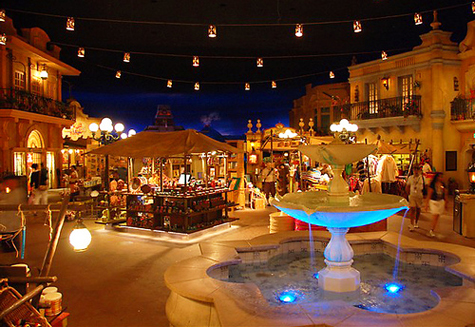
I've loved geography ever since I was a child, eventually getting a degree in it when the time came to graduate from college. And so, Epcot is easily my favorite Disney World park. In Epcot's World Showcase, particularly in the country of Mexico is what's called the Mexican Pavilion. On the outside, it appears to be an enormous Mesoamerican temple. Inside it you will find one of the greatest spaces in all of Disney World. Its interior is designed to look like a lively Mexican market at night. You enter to the sound of festive Mexican folk music with guitars and trumpets. It's very dark, but the center is lit with a warm orange glow. To each side are what appear to be store fronts, and there are kiosks in the center. Toward the rear of the large room is a pyramid with a beautiful mural on the back wall of a lush tropical forest with a lazily smoking volcano in the distance. The mural is lighted and parts of it are animated by effects.


Toward the back near the temple is a lagoon, which happens to be the last leg of the pavilion's attraction, Gran Fiesta Tour Starring the Three Caballeros. On a lower level next to the lagoon is the main dining area of the restaurant San Angel Inn. For years I've always wanted to dine there, and so I finally did this time around.


The drinks at the San Angel Inn were not bad. I and my lovely lady ordered two Margarita variations. (I later also took advantage of getting a bit of the Mezcal they had on the menu.) I got the Blood Orange Margarita, and she, the Pineapple version. (While I don't expect to get a Classic Margarita basically anywhere, I do welcome a "modern" one occasionally when it looks like it's made with good ingredients.) Both of them were good, not great, much like the food. But the atmosphere of the place is what would have me return; you dine in relative darkness, your faces lit by a small lantern on your table... all with the gentle music of marimbas in the background mixed in with the sounds of the erupting "volcano" in the distance... these combined with the pavilion's indescribable pleasant "water ride smell" makes this an experience I would recommend to anyone.


Another place at Epcot worth stopping by is the Coral Reef Restaurant, tucked in a corner of the park next to the Finding Nemo ride. The restaurant consists of a large dining room, one wall of which is the glass of the enormous aquarium that is part of the adjacent ride. The dining room is dark, and most of the light in the room comes from the fish tank. We were able to get a table right next to the glass.


I ordered one of the few drinks on the pan-Disney drink menu (which is surprisingly large) that looked decent called the Eco-tini. I know, the name doesn't really scream "quality", but it had what looked like to be decent and natural ingredients. It uses an Acai spirit called VeeV, lemon juice, ginger, and agave nectar. Sounds good, right? Well it wasn't. It was way too tangy, the kind that hurts your cheeks. I ordered a shot of vodka and added it to the drink, and it still was overpowering. (The drink came with a cute bracelet made of dried acai berries though...)


What the lady got, however, was much better. She got the Magical Star cocktail, which is one of the signature Disney drinks. Is it a balanced cocktail that is complex, interesting, and shows off the best traits of whatever high quality spirits were used to make it? Not really. But is it delicious? Yes. So delicious that I ordered one later at another Disney drinking establishment. It's served on the rocks, and has pineapple juice, Parrot Bay coconut, and X-Rated liqueur, garnished with a pineapple crown leaf. It sounds like a complete disaster, but it's actually interesting and delicious. What's more, the drink comes with a campy LED "ice cube" that sits in your drink and glows different colors. You can turn the cube off at will and take it home with you for use in your own bar. For the effect to really shine, however, you need to use it in a drink that's semi-opaque, so that the whole damn thing glows.


Finally, an honorable mention is the bar at Citricos, a classy joint located in the Grand Floridian Disney Resort. The bartender was friendly, their spirit selection was better than most bars I saw at Disney(including 2 different premium Grand Marnier vintages), and they have adorable little lamps bolted right onto the bar surface. I can't speak to the cocktail service, as we just got dessert wines (their wine selection is very impressive). Go there if you want to feel classy.


If you're a blogger and you have Disney drinking experiences, please post about them. If you're not a blogger, post about them in the comments below! :)

Sunday, April 25, 2010

Not Booze: New Mountain Dew Flavors

Truth be told, my passion for booze started when I was of the age 21, and not before. (no, really...) Before that age (which admittedly wasn't that long ago) my passion was soda. My days were spent digging up soda news and posting on soda forums. Today, I still enjoy a good soda, though my metabolism has urged me to slow it down from times past.

Particularly exciting is when I find new and limited edition products. My eyes scan the grocery store aisles and convenience store coolers and instinctively pick up on new colors or label designs (yes, I'm a sickening, brainwashed consumer), at which point I compulsively purchase them. As sad as it is, new products like these manage to get me the most visually excited in my day-to-day life, and the people that are closest to me would confirm that.

Among
The Big 3, Pepsi is always the one that is most aggressive with issuing new products (I've always enjoyed their flavored colas.), but this is particularly so with their brand, Mountain Dew. (The new stylization of the logo is actually "Mtn Dew", but that's stupid so I won't type it anymore) Between Code Red, Livewire, Pitch Black I & II, and a slough of others, the amount of variations on Mountain Dew seem to be endless... and I approve!

Like 2008, Pepsi is running another DEWmocracy campaign in 2010, where they issue several prospective new flavors of Dew, we drink as much soda as we can, and we go vote on our favorite, which then becomes a new permanent product.


The new DEWmocracy campaign has begun, and the
candidates are out for our scrutiny:

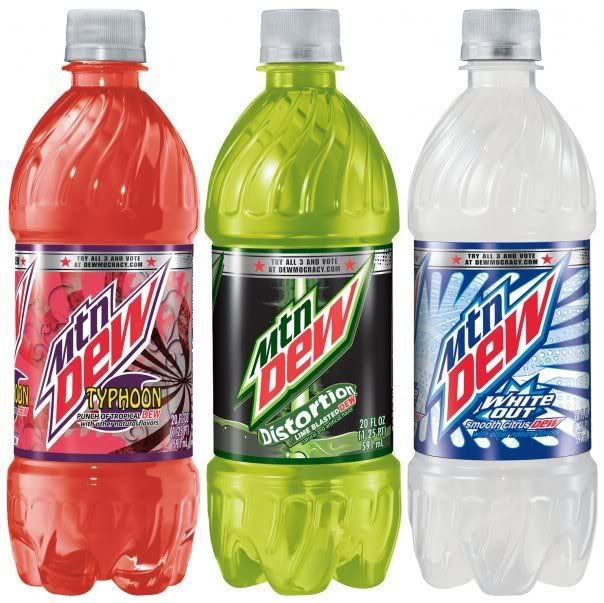
Typhoon (fruit punch flavored)

Comments: Nice!!

Distortion (lime flavored)

Comments: This could be a good sign. For ages people have gone to Taco Bell for Mountain Dew Baja Blast on tap, which is a variety of Dew which is exclusive to Taco Bell. Oh yeah, and it's delicious. I doubt this Distortion is the same product, but it's a step in the right direction, as far as I'm concerned.

White Out (smooth citrus flavored)

Comments: This is strange, of course, because Mountain Dew is a citrus-flavored soda. It turns out that this is a grapefruit flavored variation(several other grapefruits sodas are white), which is an interesting and possible good turn for the brand. I like it.


I nabbed a 12-pack of Typhoon to try first. It's unfortunate that I had to buy so much just for a taste, but that's how I react with new soda.

I was very excited about this flavor, because I'm quite the fan of fruit punch in most of its iterations. Unfortunately, this product falls short. I was hoping for it to be tangy but sweet, fruity but still Dew. What the result is, instead: a product that's much too sweet with a fairly dull flavor.

In reality, what Pepsi probably did was very much like multi-brand car manufacturers do today; they use components of one brand to save money in another. Pepsi owns Tropicana, and so I imagine they took some of their bottled Fruit Punch* and poured it into the Dew. The result is very lackluster. I hope the other flavors are worth keeping.


Incidentally, my friend Alex was able to get his hands on all three, and so I shall post some of this thoughts here. Call it a guest writer on Spirited Remix:

I tried Typhoon first. It smelled a lot like a package of Tropical Starburst. The taste was immediately very strong, but faded quickly. The Mountain Dew detracted from the fruit punch , I think. While the flavor wasn't particularly satisfying, its quick fade was still dissatisfying and ultimately left it tasting watered down a few seconds after each sip. Ultimately, I would not purchase it, but I don't know that I would classify it as bad.

White Out was second, and it, unfortunately, does not have this recommendation. While my wife was turned off by the color, comparing it to dirty water, I thought it was actually kind of nice. Like drinking a cloud. Unfortunately, White Out had none of the charm of any clouds I've met. The flavor was slightly grapefruity (a taste I cannot abide) and slighty dishwasher fluidy (a taste that, while better than grapefruit, I'm also not a fan of). Fresca, the only other grapefruitesque soda with which I am familiar, at least leaves you with a crisp and subtle taste. White Out overwhelms you with terrible and never lets you go.

Distortion is the only of the DEWmocracy beverages that I would actually consider buying. It has a strong lime flavor (although, again, the Dew actual does it no favors). "It doesn't make me want to gag" hardly seems like a strong recommendation, but, given what I had just gone through with White Out, it was the first thing that sprang to my mind upon drinking it. It's not great and it's not crisp, but it is drinkable. It tastes like a legitimate soda. Typhoon tastes like an amateurish effort by a recent Soda School graduate, while White Out tastes like God playing a sick joke on me.

So Distortion wins the DEW-off. It wasn't particularly close, despite Distortion's middling score. It is probably worth mentioning, however, that, after my wife and I had sampled each of them individually, we mixed all three flavors together into one glass. It was surprisingly better than any of the flavors individually.


*The only decent picture of Tropicana's bottled Fruit Punch product, which is strangely absent on the internet, is this, and that's even only the label (it's the 20 oz bottle version found in vending machines). The picture is from Soda Finder, a young chap who loves soda even more than me, and you can order your favorite obscure sodas from him. Call him your carbonated guardian angel.

Tuesday, January 26, 2010

Review: Seagram's 7 Dark Honey


Although my friends may call me a liquor snob, I'm really not. It's true that I do like nice things and do try to steer people in the direction of the top shelf as much as possible, but I of all people realize that our wallets can't always follow. Today we shall lower our eyes to the middle shelf of our hypothetical spirits-vending establishment and examine briefly the Seagram brand.


Seagram's brand of spirits is very much a hit and miss model. A look at their good products begins with their gin. Even though I find my palate for gins to be still evolving, Seagram's gin is not to be discounted. It is an American-style gin (as opposed to London Dry) which means that the tongue isn't assailed by the taste of Christmas trees (which I actually like), though American-style gins vary widely in flavor. Seagram's gin's claim to fame is that it is one of the only gins to be lightly aged in barrels while almost all others are un-aged. The resulting taste is one similar to a London Dry, but much more mellow with slight flavors of oak... it makes a killer Gimlet. As an admitted non-expert on vodka, I can also say that Seagram's Vodka is also a great buy for the price. They both have really great bottles too.

Seagram's Smooth Brazilian Rum is a newly-launched product, and as a drinker much more versed in rum than other spirits, I have to say that it's simply a fine product. It's a rum produced from sugar cane juice instead of molasses, in the style of Rhum Agricole and Cachaca, such that its flavor is more on the caney and grassy side rather than a full-bodied and dry one. The Drink Hacker said this about the stuff: "This is actually drinkable on its own — when’s the last time you said that about a $12 rum?" The gin, vodka, and rum are all available for $15 dollars or (much) less, marking a considerable value for those looking to save a few bucks. As I've said before, being a liquor fan isn't cheap.

But Seagram's also markets products that don't really hit the mark. Notable are their Twisted Gins, which are basically some of the only flavored gins around, and they're just hard to take seriously. Also for sale is Seagram's "Gin & Juice", which are barely palatable syrupy concoctions that I can only assume are artificially colored and flavored (but I'm not positive). And lastly worth mentioning is Seagram's 7 Crown whiskey, which is an American blended whiskey (a dying breed) that's more often found on the bottom shelf than the middle. It's a long standing brand and even has its own cocktail, but it's really not a whiskey taken very seriously among whiskey-drinkers. In preparation for this post I did a quick tasting of the stuff at a local bar, and some notes I took down consisted of "alcoholy", "mellow", and "one-sided".


The Review
Seagram's 7 Dark Honey

I was interested to learn that Seagram's has a new product called Seagram's 7 Dark Honey which is a honey-flavored whiskey, and certainly not the first one on the market. This bottle was actually given to me for free to review, and so that's what I shall do. However, because this spirit clearly uses 7 Crown whiskey as a springboard, I really wasn't sure what to expect. For starters, the bottle is pretty cool, and is actually the same bottle used for Captain Morgan's Parrot Bay brand. This stuff is sweetened like a liqueur, and clocks in at 71 proof. (Not bad!)

It turns out that there's a mild controversy on the internet concerning how Seagram's may be promoting their products via marketers commenting on blog posts who pose as though they're normal readers, which can be read about here. I'll note that the person in question(according to that link) has also posted a comment on THIS blog several months ago, shortly before another person (the same one who sent me this product) commented, and both comments talked positively toward a brand name that I've never even uttered on this blog. When the Federal Government gets involved in this kind of stuff, you can imagine why I hold full disclosure in high esteem. With that said, I'm no less grateful or humbled to have received this gift; it's as if people think I know what the hell I'm talking about! But shall I be adding to this product's internet hype? No, I imagine I won't...

In the Glass

Nothing too groundbreaking here. It's the color of whiskey and is viscous like a liqueur.


Smell

Almost nothing but alcohol. I tried really hard, and I finally discerned a faint smell of wheat akin to the original 7 Crown whiskey. I'm also sensing a generic "sweet" smell... perhaps it's brown sugar, but it's definitely not honey. Near the end I detected something citrusy, which was a little strange.


Taste

Luckily, the first flavor I got was honey, but it was soon to be replaced with cinnamon, and then more alcohol. I tasted a fleeting wheat, much like the smell, before the alcohol burned my tongue a bit, and then the strong sweetness took over. To be honest, the mouth feel was quite nice. When it goes down the hatch, it's just fine, and finally flavors of brown sugar and cinnamon... and then more alcohol. Overall, despite all the alcohol burn, it's a pleasant experience. Perhaps disappointingly, its flavor is on the subtle side, much like it's mother, Seagram's 7 Crown. An added ice cube changed nothing of this experience.

Mixing

I set out to find a vehicle that could successfully deliver this stuff, and I did it alongside a fine young lady that (somehow) continually finds that I'm pleasant company. (DJ HawaiianSkirt, you could call her...) I knew we could do it. We tried some of the options that the official Seagram's literature suggested: as a chilled shot, on ice, with a little lime, and with cola. The shot tasted mostly of alcohol, and we found that so long as 7 Dark Honey is mixed with anything, its flavor is dominated and it "disappears" into the drink. (Seriously, when your product's flavor manages to hide in a small glass of seltzer, you know you have a problem.) Surprisingly, it works passably in a hot toddy (made with hot water, not tea) having the 7 Dark Honey replace both the whiskey and honey in the recipe. Also, the stuff isn't unpleasant on ice (but a lemon twist dashes its flavor) where it mysteriously has absolutely no aftertaste.


Conclusion

So, what's the final verdict? Well, I think 7 Dark Honey hits a little below Seagram's average mark. It's an overall pleasant liqueur, but its flavor is too subtle. It's nice on the rocks, but it is certain that your favorite mixer (unless it's flat water) will destroy what subtle character it has... otherwise, it's like using a sweet 71 proof vodka. You want a sweet honey liqueur that doesn't taste like whiskey? There's a better one that already exists, and it's called Barenjager. Perhaps this is a "gateway whiskey", perhaps it's a drama-free mixer (read: doesn't taste like booze), but whatever it is, it's not versatile, and not something for which I have much use.


Value (bonus section to the review!)

But here's the problem: I picked up a bottle of Wild Turkey American Honey, 7 Dark Honey's competitor. It's a bourbon-based liqueur, also honey-flavored, and also 71 proof(erie...). I had had the stuff before, but I bought more solely for this comparison. AH's smell blows Seagram's away... its aroma is bold, and actually of whiskey... and there's honey too, with a teasing herbal complexity. The taste is also of whiskey, and with a flavor of honey much more pronounced than Seagram's. The mouth feel is even better, the flavor more complex, even with hints of lemon at the swallow. And the punctuation to all this? Froogle says that AH is an average of $5-6 more expensive than 7DH. And so, simply, the final question is: Does Seagram's 7 Dark Honey have the best value among the whiskey-based honey liqueur products on the market today, or is it even worth your purchase? No.

Addendum: Evan Williams created a honey whiskey that's better than both the products by Seagram and Wild Turkey. My review of it can be found here.

Tuesday, December 1, 2009

Wasmund's Single Malt Review


The above picture isn't a publicity shot... it's a picture that my friend took behind Wasmund's distillery, where they have a small table and chairs
set next to the local stream.

If you're tired about hearing me talk about Wasmund's Whisky, great! Because that means you've been reading my blog. This will be one of my final posts concerning their products. There are just too many things to say about them. But today, at least momentarily, I will be shedding my fanboyism and will try to soberly review one of their products.


The Whisky
Wasmund's Single Malt

Wasmund's Single Malt is the only whiskey in the United States that is malted and distilled under the same roof. The enterprise rests on the foothills of Appalachia in a small town called Sperryville in the Commonwealth of Virginia. The small distillery is run by a half dozen people, most of whom are family. They take local barley, malt it with local water, smoke-dry it with local fruitwood, mash it with more local water, distill it, age it in local barrels, and bottle-proof it with more local water. The whisky itself is usually less than a year old in age; the small barrels and fruitwood chips present in each barrel accelerate the maturation. The final product is a unique whiskey and does a fine job of turning professional heads. I'm sorry for the inconsistencies in spelling "whiskey". Rick Wasmund, classically trained in Scotland, insists the absence of the "e" when referring to his specific whisky. Thus, I will attempt to walk this tight rope.

In the Glass

Wasmund's whisky is of a color much more dark and red than your average whiskey, or even single malt. It's like some old Scot poured a glass from his favorite bottle and threw in a dash of coffee and red wine. It swirls readily and its legs are minimal; this is just too young of a whiskey to wow you with texture.

Smell

The first thing you notice is smoke, but instead of a slight peat smoke like that of Scotch, you get an assault of wood smoke on the nose, like walking into a restaurant that sells BBQ, or Wasmund's own distillery, for that matter. Continuing on, there's a warm presence of dried leaves, and an earthiness so earthy that it borders on dirt (in a good way). A long sniff reveals foundations of subdued malt/barley and dried apples(probably because of the applewood used to smoke the malt). Lastly, you finish with the hard-to-describe smell of fresh running water, often found near a stream or in a wet cave.

Taste

Much like your nose, your tongue will be overwhelmed with smoke. But this time you'll be able to discern the flavor of dried cherries in it(because the malt is also dried with cherrywood). Again, you'll notice flavors of dried leaves as well, which is my personal favorite. You'll taste more earthiness in a slight flavor of moss. Lastly, you'll find the maltiness, and finish with a sweetness that's not unlike the taste of marshmallows.

Conclusion

Wasmund's Single Malt is unlike any other whiskey, stylistically. Its sometimes-rough and thin mouth feel will confuse you when the incredibly complex flavors and aromas hit you, perhaps to its detriment. This is neither a whiskey with which to become inebriated nor something to hold in your hand as you socialize with friends or family at some party; it's to be drunk alone, in the quiet, in contemplation and concentration, where all of its flavors can be noticed and recognized. Drinking Wasmund's is like cracking open a textbook and learning something, then having your opinions challenged and again reinforced... it's a didactic and introspective experience. Although I have to say, making Wasmund's Old Fashioned doesn't hurt the whisky's character. At a price cheaper than most Scottish 12-year Single Malts, Wasmund's Single Malt is invaluable as a conversation piece and a study of spirits in general, and a bold statement on what an American single malt can be. Word has it that Wasmund's products are available in most of the eastern Midwest and mid-Atlantic East Coast, and their distribution is spreading. If your local store doesn't have it, they can probably order it.

With the review over, I'm going to add a few more points on why I think this product is so important to the culture of spirits today:

1) Innovation. Though Wasmund uses old methods that are tried and true for inspiration, his product mimics nothing. While its geography is American and its style is European, it does not taste remotely like either. Even better, the uniqueness of his product is not a gimmick. Brush your gaze across the vodka shelf in your local liquor store and you'll see plenty of recently-launched and soon-to-be-discontinued brands that were forged completely on a business model powered by brand marketing and not product quality. Wasmund's accolades and admittedly humble popularity come from the fact that he's making a product unlike any other, and a good one at that. In a land where Bacardi and Jim Beam dominate the industry... this is a breath of fresh air.

2) Local economy. I won't harp on this, because I myself tire of hearing it sometimes... Wasmund creates his products using completely local ingredients, which not only guarantees freshness, but displays a preference of quality over price; local ingredients aren't always the cheapest anymore, what with today's age of Walmart-style transportation networks. It also makes sense to help energize the economy around you and not one far away... after all, when everyone around you is living well, you probably will too.

3) Terroir. This is the most important, and a result of reason #2. Terroir is the effect that a landscape has on the taste of a food product. For instance, if a winery in France packed up and moved their personnel, equipment, and grape seeds to California to reestablish their enterprise in exactly the same way... their wine would taste different. Maybe not much, but it would taste different. The difference in soil composition, rainfall amounts, and even the chemistry of the air would impart slight variables that would ultimately change the character of the wine. Many people claim that the water in New York City is what makes the pizza there so delicious... I for one think that claim is a bit exaggerated, but nevertheless, it's still terroir. Wasmund's whisky is packed with terroir. Every single input ingredient in the process is strictly local... and by "local", I mean within about a 50 mile radius, if I'm not mistaken. Even though it might sound crazy, the taste of Wasmund's whisky transports me to the Appalachians in the fall, and I suppose that's no surprise. Their whisky doesn't let you forget where the product was made, and that's something exciting. The 2009 International Review of Spirits commented that Wasmund's "finishes with a very long, slowly evolving, mossy river stone, peat, cocoa, cereal, and pepper fade." So in the end, the word "earthy" manages to describe this products taste, ingredients, and process.

Wasmund's went on in the aforementioned contest to score 93 out of 100 points.

Monday, November 2, 2009

The Cask: Part 3, Final. The Cask, Round 2: Part 1


So, after a little over 5 months in the barrel, my rye whisky is finally mature enough to exit, I figure. You can read about my at-home aging exploits here and here. I originally dropped 1.5L of Wasmund’s Rye Spirit into this small oak barrel, and I’ve been letting it sit until now.

As soon as I evacuated the whisky(spelled that way by Wasmund’s request), the first thing I noticed was the volume. Aside of the small pours I’ve been taking out here and there for myself and a few of my friends, I was very surprised at the Angel’s Share. I started the experiment with two 750mL bottles, and the result is less than one of those bottles. I suppose it makes sense: the increased surface area of the small barrel which allows me to mature a spirit much quicker than a big distillery also accelerates the rate at which the alcohol (and water) evaporates through the barrel. So, my end product is not great in amount, but great in flavor instead.

I began with Wasmund’s Rye, but the version I had was almost completely unaged, clear as water. What I have now is a whiskey that’s darker than any I’ve ever seen on the shelves. You can see my short review of the unaged whisky here. And now, a review of the final product:


Wasmund’s Rye Spirit, at-home aged


Smell

The smell of this is drastically different than from the start, although it's still fairly simple. Five months ago it smelled grassy and pungent, assaulting the nose with alcohol. Now, it smells overwhelmingly of smoke and oak, with still the mischievous tones of butterscotch, as I began to notice 2 months ago.

Taste

The smoke and oak still dominate here. It’s impossible to escape the smoke of Wasmund’s whisky, especially considering that they smoke their malted barley with fruitwoods. The pungency of the rye is still there. It still tastes fairly high proof, perhaps still over 100. (Really?? I would have thought just about all of it had evaporated :D) The butterscotch smell does not carry over to the palate… instead you taste honey and spice. You can’t really buy whiskies quite this complex unless you begin to pay over $100… and come to think about the spending for this project… I just about did.

Ice cube

The high proof warrants the ice cube, but the taste of the stuff doesn’t change too much with water. The only difference I notice is that both the pungent rye and smoke become more pronounced. Fabulous!


What’s next for the barrel?

I’ll tell you what’s next: rum. Lots of it. I do hate conforming, but I’m hardly one to shirk tradition. Rum fans know that aged rum is often matured in oak barrels that were previously used for whiskey… bourbon, most often. Well, all I got is a rye barrel, so I’m using that.

I’ve been given conflicting advice on how exactly to begin aging this rum. Do I try to re-char the inside of the barrel? Do I let the barrel air out? Do I “flush” the barrel with water for a few days?

I decided to put in the rum without re-charring the barrel. I really don’t have the resources (or expertise) to do it, not to mention that this small barrel wasn’t designed to be handled so. I didn’t flush the barrel; I want a strong flavor to the rum I’m putting in it, so all I did was “air out” the barrel for about 12-24 hours, and then began to pour.

Pour what? Cruzan Estate Light. Two full liters of it. Cruzan (CROO-zhun) is a company based in St. Croix in the US Virgin Islands, and their rums are all fairly subtle in flavor, and are often compared to rum from Puerto Rico. Cruzan Estate Light, their lightest product, is one of the best rum values of which I know. When anybody asks me which rum they should buy for Mojitos, or cola, etc... I always tell them Cruzan. (Even though Cruzan just limited their Estate Light aging time from 2 years down to 14 months, it’s still great.) Cruzan is usually cheaper than Bacardi (depending on your state’s distribution system), and while Bacardi Superior usually tastes and smells like rubbing alcohol, the Cruzan is so good that it can be sipped with an ice cube. To me, Cruzan tastes mostly woody with hints of almond and vanilla. You’ll notice that it’s not completely clear, but has a nice beige tint to it. I look forward to seeing how it holds up under the oakey onslaught inside the barrel. So, for the love of your savior, never buy anything Bacardi again (unless it’s Bacardi 8 or Bacardi Solera or another of the few limited products they make), and buy Cruzan Estate Light instead.


So there it is. The second batch of spirit is already aging in the Little Barrel that Could. Any suggestions on what I should age after the rum? I'm thinking Port or Sherry.