Showing posts with label rule. Show all posts

Wednesday, April 17, 2013

Mixology Monday LXXII: Drink Your Vegetables

This month's Mixology Monday is hosted by Rowen of the Fogged In Lounge, who is perhaps my favorite blogger who still posts regularly.  I expected a good theme, and Rowen didn't let me down, though I should probably not be surprised that it's a hard one: Drink Your Vegetables.


Instead of taking a safe route for this post, I'll instead expand upon a simple rule that I've discovered over the years: that the Martini is a bulletproof recipient of almost any flavor you throw at it.  Now look, I'm not going to wax poetic about how perfect the Martini is, and I'm also not going to suggest that putting weak bullshit like curacao or Angostura bitters in your Martini is exciting and new at this point.  Anyone who knows my blog knows that I post some unorthodox shit.  I don't intend to disappoint.

I'm here to suggest that you try to get a bit crazy when it comes to adding things to your Martini, and you might be surprised at how well it works, in the end.  If you're in a floral mood one day, I might suggest adding a few heavy dashes of rhubarb bitters to your Martini; I've also even been known to put a drop of rosewater in the mixing glass before stirring.  If you can tolerate a shaken Martini, your options widen.  For a fruity mood, try adding a few pieces of citrus peel into the shaker and let the ice pulverize it.  Try that with chunks of pineapple, pear, or ginger.  For an herbal mood, try shaking with basil leaves.  A savory mood is my favorite...  shake the Martini with a sprig of rosemary.  Or add a dash of mezcal or Islay Scotch.


Today I'm taking you to two extremes of savory and herbal Martinis, respectively.  The former is a way to drink your vegetables, and the latter is simply a bonus.  I decided to end up naming them due to cocktail ego, but I won't be giving them the Original Remix tag.  I ended up calling them the Chef's and Gardener's Martinis.


Martini au Chef de Cuisine

1.75 oz gin
.5 oz dry vermouth
1 drop (not dash) celery bitters (optional)
1 half thin slice of red onion

Shake all ingredients with ice.  Double strain into a cocktail glass.  Olive or cocktail onion garnish.

The onion doesn't taste like you think it will.  It adds a sweetness to the drink and perfumes it in a way that's not very much like onion.  This is a great choice if you want an extra savory Martini before a big meal.


Martini au Jardinier

2 oz gin
.5 oz dry vermouth
.25 oz absithe
1 sprig parsley
2 sprigs cilantro

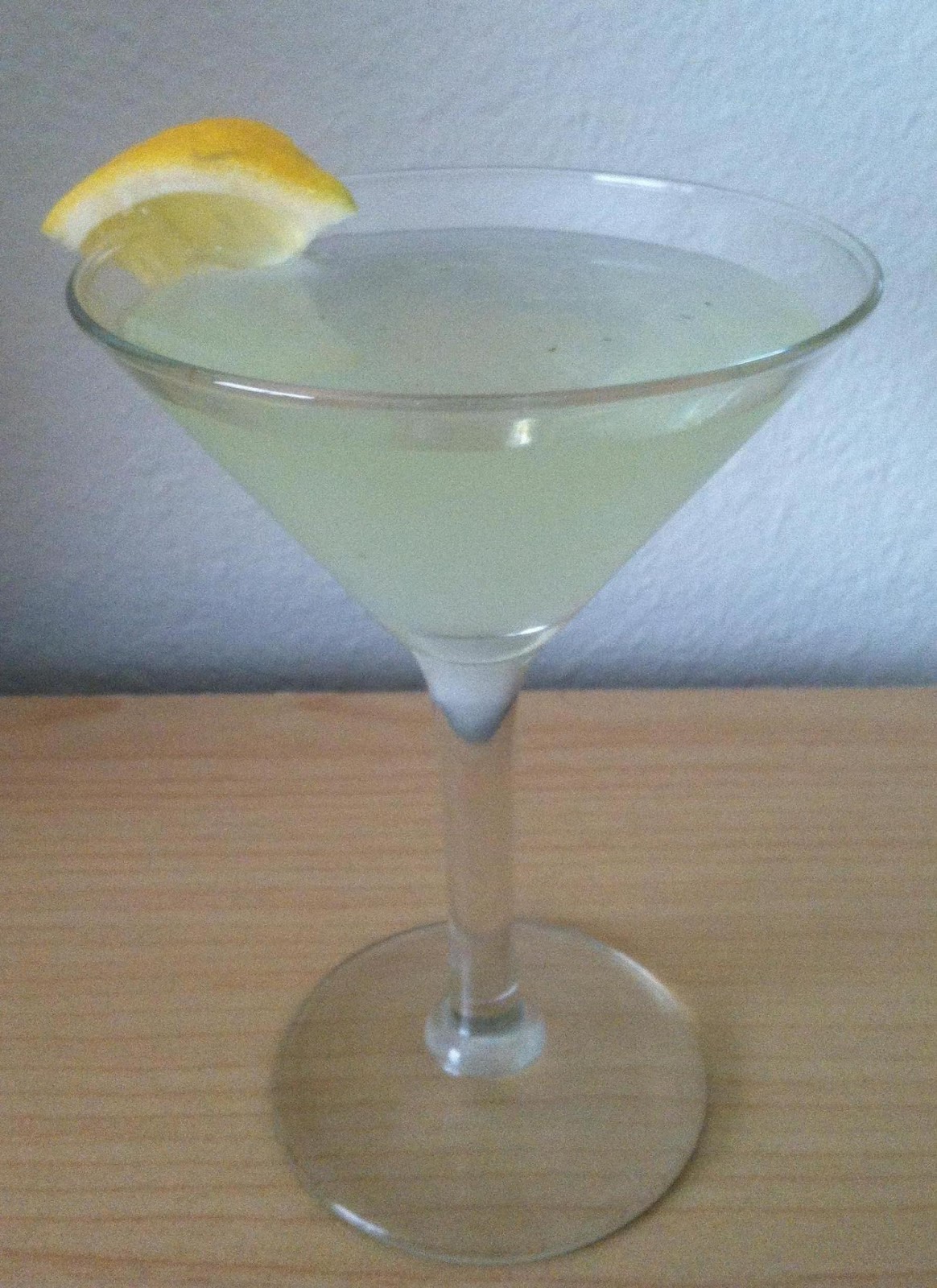
Chop herbs with 2 or 3 cuts, and shake all ingredients with ice.  Double strain into a cocktail glass.  Half lemon wedge garnish.

If you never muddle mint in your Juleps and are afraid of bitter chlorophyll, this isn't the drink for you.

Thursday, June 21, 2012

Infusion #6: Limoncello

Summer's cosmically here, and you should sip some chilled limoncello to welcome it properly.

Limoncello is an Italian lemon liqueur which is prolific in Italy and, if you've been so fortunate to have visited the place, that would already be clear to you. Anecdotal evidence has told me that just about every serious meal in Italy is followed by a small chilled glass of limoncello, and it's almost offensive if you refuse it. It's generally served neat and chilled, though you can really take it any way you like it, and you can even mix with it.

The bad news is that limoncello, for some reason, isn't very easy to find in stores. The good news is that it is easy as hell to make. The better news is that once you've mastered making limoncello, you've unlocked an easy way to make tons of kinds of your own liqueurs at home.

Making your own limoncello follows a beautiful and modular process that's easily adapted:

Step 1) Fill a vessel (preferably glass... empty booze bottles work) with an amount of vodka.

Step 2) Place into the same vessel an amount of lemon zest.

Step 3) Let vessel sit for an amount of time.

Step 4) Strain the zest out of the vodka, and add some amount of sugar.

(All ingredient and time amounts are nebulous because it's all to taste. A higher and lower spirit/flavorant balance will require more or less time for a proper infusion, respectively.  You should at least be using about 1 lemon's worth of zest for each cup of vodka.  The infusion should probably sit undisturbed for at least a week before straining.)

As I've been quoted saying in articles before, this is a GIGO situation: infusing crappy vodka with lemon peels doesn't improve how the vodka tastes. You don't need to use Grey Goose, but a middle shelf alternative should be fine.

Tradition dictates your lemon zest should be completely devoid of pith, which is bitter. But if you like a bitter note to your limoncello, you won't hear me complain. You can avoid pith in a variety of ways. I like to peel the lemons with a vegetable peeler, and then use the flexible tip of a sharp knife to shave most of the pith off from the back (I'm not a perfectionist). But if you want no pith at all, I would say the easiest way is to use a micro-plane to zest the fruit very lightly. Whether your zest is in long wide strips or fine flecks, it doesn't matter.


After letting the mixture sit, strain out the solids using a coffee filter. To this infused spirit you can add sugar. Since sugar does not dissolve well in alcohol, you should firstly make a syrup by dissolving the sugar into water, and then add the syrup to the spirit. You can make a simple syrup or a rich simple syrup, depending on how much additional water you'd like to add to your spirit to sweeten it, thereby lowering its proof.


Once you add your sweetener, you're ready to drink.  Chilled in the freezer and served neat is traditional, but I'll take it any way.

What's a good limoncello cocktail?  I might first direct you to my own Southern Soprano...

The directions above are an easy guideline which you can use in more generic ways than it seems.  All you need is 1) a solvent, 2) a flavorant, and 3) a sweetener.  In the case of limoncello, those 3 variables end up looking like: vodka, lemon peel, and sugar

I'll leave you with a list of variations that I myself have tried with varying degrees of success, some of whose names are made up and some of whose are not...

Meyer limoncello: vodka, Meyer lemon peel, sugar
Limonmielo: vodka, lemon peel, honey
Limettacello: vodka, lime peel, sugar - my personal favorite
Pompelmocello: vodka, grapefruit peel, sugar
Pomelocello: vodka, pomelo peel, sugar
Uglicello: vodka, Uglifruit peel, sugar
Gimoncello: gin, lemon peel, sugar
Mojitocello: white rum, lime peel & mint, sugar

Friday, June 3, 2011

Old Fashioned: Your Syrup Need Not Be Simple

I talk a lot about Old Fashioned cocktails on this site. It's because I really enjoy spirit-forward stiff drinks, and the Old Fashioned is the grandfather of them all. I won't talk about how, though, because Robert Hess does it best below. (Skip to the 4-minute mark.) Long story short: the word "cocktail" originally meant "Old Fashioned" (or vice versa).

What used to be an old-timey way to make a spirit more drinkable is still a way to make a spirit more drinkable. To make an Old Fashioned cocktail (hereafter OF) is simple: you begin with about 2 ounces of your favorite spirit, you add a dash or two of cocktail bitters, and a heavy dash of sugar syrup. The peel of a citrus fruit is often added. You stir with ice, and you drink.

The OF is way to celebrate a spirit; its bitters and sugar (and sometimes citrus peel) are a way of seasoning a spirit without masking it, much like you'd do with food.

For example, roasted chicken may be delicious, but few would argue that roasted chicken can't be elevated with just a bit of garlic and herbs; steak benefits from a bit of salt and maybe even pepper; many types of fish benefit from a squeeze of lemon; cooked broccoli benefits from a bit of melted butter. Many spirits benefit from a simple seasoning as well.

Traditional OFs are made with brown spirits along with Angostura aromatic bitters. When it comes to lighter spirits, there are plenty of bitters options as well, like the next two most popular types, orange bitters and Peychaud's bitters(which is a deep red bitters and tastes of muted anise). Other types include lemon, grapefruit, cherry, peach, rhubarb, celery, chocolate... and then there are interesting blends such as whiskey barrel, tiki, creole, and the list goes on. Yours truly has created his own coffee bitters and floral bitters, even. Cocktail Kingdom remains one of the authorities on purchasing bitters on the web.

The Kaiser Penguin humorously held a small contest to see which booze bloggers had the most types of bitters in their possession... be sure to check the comments in the post to see the tally.

The fun part begins when you start creating combinations for your OF. Which bitters should or could go with which spirits? A few examples: chocolate bitters with brandy; grapefruit bitters with tequila; celery bitters with gin; tiki bitters with aged rum; orange bitters with white rum; lemon bitters with pisco.

BUT WAIT.

Your bitters is not the only dimension with which you can be creative for your OF. There are tons of different types of syrups that you can buy and even more that you can make on your own. Using a flavored syrup is a way to add another layer of complexity to your drink.

Below are examples of syrups which can be found in your local grocery store, in the coffee and pancake sections. While you may chuckle at the idea of using such syrups in a cocktail, realize that a syrup is a syrup, so long as it uses high quality and natural ingredients. A little research on the internet reveals great places to buy syrups with a wide selection of flavors.


But be warned: the more complex your spirit's flavor is, the fewer layers of flavor it needs on top of it. It may be a fine idea, for example, to make a Famous Grouse Scotch OF with Whiskey Barrel bitters and clove flavored syrup, but your glass of Balvenie 12 may not need such a distracting mask over its face.

Don't be hypocritical here. If you have no problem with the layering of flavors in your bitters (there are over 40 in Angostura alone), then how could you be against adding another flavor via syrup, if you knew it was of good quality? If it was perfectly acceptable to add a flavored bitters to your spirits, then why would a flavored syrup be too much?

Be open minded when thinking about syrups for possible OFs. On a whim one day I picked up a bottle of Margie's banana syrup from my local grocery store. It's opaque and pulpy... almost like a cross between banana syrup and banana purée. My new favorite way to drink rum is mixed with this stuff, and it makes a killer OF.

I also picked up some cola syrup from a local Williams Sonoma. Its intended use is to be mixed with seltzer to make your own cola, but I mix it with spirits with great results. Even a syrup as powerful as my passionfruit syrup can be mixed into an OF. You can also make a syrup out of a favorite spice or tea by boiling (or simply soaking) it in water and mixing it with sugar.

Dave of the Sugar House Blog gives us a fine example of a good combination: mezcal, Peychaud's bitters, and cucumber syrup. Dr. Bamboo tweets his surprise on how well his ginger-mint syrup works in a whiskey OF... well I'm certainly not surprised! The combinations are endless, and you have the ability build your favorite flavors all into one cocktail.

OFs usually have a peel of citrus fruit for a garnish. If you really start getting wild with your OF flavor combinations, you may find that citrus peel isn't always welcome. When you have an unorthodox OF, you can have an unorthodox garnish as well. Here, I made an apple brandy OF with a cinnamon stick garnish, because I felt that citrus wouldn't go well with it.. You can always forgo the garnish as well.

Here are some of the wilder OFs I've made recently. I hope these inspire you to deviate from normal simple syrup and aromatic bitters, and explore the blank canvass that is the OF.


Rum & Cola Old Fashioned

aged rum
Sonoma Cola Syrup
Fee's Whiskey Barrel bitters
lime peel

(As I've said before, lime twists/peels are best acquired from a hard lime if you can manage to choose one along with the soft ones that you pick out at the store for juicing.)


Gin Old Fashioned

gin
Red Zinger Syrup
lemon bitters
lemon peel


Light Rum Old Fashioned

light rum
Margie's Banana Syrup
Angostura bitters
lime peel


Jack Rose Old Fashioned

apple brandy
grenadine
lemon bitters
lemon peel

Thursday, March 31, 2011

Fame ≠ Quality

Have you ever made a drink recipe that you got from a book or online that's simply terrible? I know I have. And when this happens, my (and perhaps your) first thoughts turn self-deprecating... what did I do wrong? Did I use the right amount of ingredients? Perhaps the type of spirit I used wasn't of the right style. Were my ingredients fresh enough?

Surely an occurrence like this is more common when using new and green recipes from the internet, but what if it happens when using an old book... when you make a recipe that's supposedly tried and true? Surely you're the one at fault, not the recipe... right?


Rowen over at the Fogged In Lounge has just finished an in-depth exploration of this problem. He spent the entire month of March getting intimate with the Bronx cocktail. You can find the recipe for the Bronx in just about any respectable cocktail book, and yet among enthusiasts, the drink is hardly lauded. I am of the same sentiment; the Bronx, to me, feels flat and one dimensional.

Rowen took the time to make a multitude of variations on the Bronx to see what worked in the drink and what did not, which you can read about here. In his wrap-up of the experiment, Rowen concluded that what the Bronx was missing was essentially some type of bitters, which he finds tends to finally unite the flavors of the rest of the drink. Despite the fact that you'll probably only ever see the Bronx call for 4 ingredients, to quote Rowen, "The Bronx is really a 5-ingredient cocktail."

Even Erik of the Underhill-Lounge, in his run-through of all the cocktails in the Savoy, admits that the drink is better with bitters, and he even uses a bitter vermouth when preparing the drink.

This all goes to show an important lesson: Don't assume that a recipe is great just because it's in a book, no matter how prestigious. And a corollary to that: You're allowed to dislike whatever you want, despite what anyone says.

Monday, March 14, 2011

Rule: Mixology as Alchemy

I know the post title is really lame and trite, but stay with me here...

The mixing of different ingredients into various combinations can invoke very distinct results.

Some spirit-forward recipes like the Old Fashioned or the (modern) Martini are meant for certain ingredients to "sing the lead" in a mixture, and they use smaller amounts of other ingredients in order to accent the lead singer.

Other recipes, I would argue, work correctly simply because they have some combination of ingredients that taste really good together. Examples I can think of are the Gimlet, the Mojito, the Margarita, or the Tom Collins.

Some recipes are based off of contrast. A good example I know of is the Oriental cocktail, where all of its ingredients battle over your taste buds' attention.

But once in a while you'll find a recipe that, without getting too poetic, borders on alchemy. I'm talking about a recipe where the product is truly greater than the sum of its parts. Recipes like these are often a big surprise because they're so unpredictable.

A prime example of this is an original recipe from Dave of the Sugar House Blog. His cocktail, the Crimson Dynamo, uses ingredients that I don't really like, but the resulting drink is something I find fairly palatable. (It's a faux pas to be a booze blogger and admit that you don't like a certain ingredient. But with me, it's usually a temporary state. You could say that these are ingredients I don't like yet.)

Campari is an herbal Italian liqueur called an amaro. Don't let its gorgeous red color and the word "liqueur" fool you... its bitterness is so overwhelming that most novices who drink it will grimace before spitting it out. It goes toe-to-toe with Fernet Branca as one of the most bitter brews on the liquor store shelf you can find. I don't dislike the stuff per se... I can even drink it alone on ice without a problem, but I'm just not in love with it. I find that most cocktails containing it aren't balanced, and they leave the Campari unchecked to bully around the other ingredients.

Maraschino(the "ch" is pronounced like a "k") is another Italian ingredient made from the cherries of the Marasca type. Completely unlike what most people in the western hemisphere may think is Maraschino, this stuff is completely clear and has a biting cherry character. The flavor is closer to cough syrup than anything a beginner might be expecting. It's a common ingredient used in vintage cocktails, and even in a few tiki drinks. I personally think that almost any drink that uses more than 1/4 ounce of the stuff is completely dominated by it, and in a way that's not pleasant.


Islay is a type of Single Malt Scotch Whisky which is produced on the isle of Islay. Islay whiskies are generally known to be heavily peated, which is a process by which the distiller dries the fermentation's source of malted barely under a fire of burning peat. While the distilled spirit is aging in barrels later on, master blenders of Islay whisky are also known to leave the warehouse doors open to encourage the nearby ocean air to mingle around the barrels, which are surprisingly permeable. The result of all this is a whisky that is earthy, pungent, smokey, medicinal, and sometimes even tastes of iodine and seaweed. The stuff is so strong that Robert Hess uses it as if it were bitters. I love Scotch, but I don't even like Islay Scotch.

Imagine my intrigue when I saw Dave post a drink that uses only these three ingredients, and what's even better, he declares it as "everything [he] want[s] out of life." I smartly assumed that Dave is a man more sage than I, and so, hands quivering, I gave the drink a whirl.


Crimson Dynamo

1.5 oz Islay Single Malt Scotch
1 oz Campari
.5 oz Maraschino liqueur

Stir ingredients together with ice, and strain into a cocktail glass. Garnish with an orange twist.


The Islay base of this drink still makes it pretty challenging for me. Both the overwhelming flavor and aroma is of pungent iodine. But the sip is much less diabolical overall than I had expected. Amazingly, each of the three strong ingredients manage to keep each other in check. The whisky is by far the most wiley, but much of its flavor disappears in the drink, with only the occasional smokiness and medicinal iodine coming through to numb my tongue. The whisky and Maraschino manage to pummel the Campari's flavor mostly into submission, so that in the end it only offers bitterness and a peppery spiciness. The Maraschino comes all the way through, but is largely subdued by the other two gargantuan ingredients, and it provides the sweetness underlying the cocktail. Instead of these ingredients joining together in some awful cacophony, they join together in a harmony of temperance, and I am in awe.

Over the few years that I've been exploring spirits and cocktails, I've slowly and surely come upon an uncomfortable truth that I can't help but humbly accept. The DJ's 2nd rule of the house: You cannot always know how a recipe will taste by simply looking at the ingredients, despite how experienced you may be.

Monday, August 3, 2009

A Golden Rule: Alexander Cocktail Ratio

Mixology isn't the most accessible craft. Notwithstanding things like the cost of equipment and ingredients, the green home bartender that is not armed with tried-and-true recipes can be fairly dangerous. Regardless of what sorority girls may have told you(the ones you actually got to talk to), you can't just throw a bunch of stuff together and get a decent drink.

Now look, I'm not saying that it's not ok to put a nice generous pour of your favorite liquor into your favorite soda, because that can be quite nice (although some of my less successful desperate attempts at bars have been gin & Pepsi and brandy & ginger ale), but as soon as more than one glass bottle is upturned, most people unknowingly enter a minefield of mediocrity.

Allow me to save the day. Ahem....

Dust off one of the older cocktail books that you have and look up the Alexander. Yep, that's right. No, not the Brandy Alexander, but the original. I give you here an ironclad rule of mixology; the Alexander ratio. One part base spirit; one part liqueur; one part cream. Shake with ice, strain into a glass.

The original Alexander is made with gin. Shame on Robert Hess for calling for his Alexander to be made with brandy in his book... Today, you'll see Brandy Alexanders much more often than the original. Why? I don't know, probably because it's better. I find the botanicals of the gin can't stand up to either creme de cacao or cream(at least in those ratios) better than a good aged brandy can. But for the sake of old schooliness, I'm going to post the Alexander cocktail:


Alexander

1 oz gin
1 oz creme de cacao
1 oz cream

Shake ingredients with ice. Strain into cocktail glass.


However, what I'm getting at is that the Alexander ratio is a surprisingly bulletproof one for you to start making your own delicious cocktails, no matter how crazy you get. You can mix almost anything with the creme de cacao, but you can get much crazier than that: brandy and ginger liqueur, tequila and triple sec, rum and amaretto, vodka and Midori, bourbon and Tuaca, etc. (Several cocktails you know of might be Alexander variations, such as the Grasshopper or the Silver Jubilee, although the former is an ultra-sweet variation, and as you can see with the latter, there are plenty of variations in proportion.)

As a personal preference, I like to throttle down the cream to 3/4 parts instead of 1; some flavors just can't stand up to so much cream. I wouldn't be against advising you to throw in some bitters whenever you can. Also, I find that if you want to use a syrup instead of a liqueur, take a 1/2 part away from the sweet proportion and give it back to the hard spirit, making the new ratio 1.5:0.5:1 instead of 1:1:1. With that, you could start using combos like rum and falernum, or gin and raspberry syrup, etc.

Anyway, before I go, I'll throw in my own Alexander variation to get the party started. Do yourself a favor and pick up some cream on the way home and give this ratio a try tonight. You'll have a lot of fun. Oh, and leave the half-and-half for the morning coffee. If you think you can make a lighter and healthier Alexander with half-and-half instead of cream, you're wrong.

So, the next time you're at a frat party(aren't you a little old for that, anyway?) and some wasted homey in flip-flops and a t-shirt hands you a plastic red cup full of goopy nonsense which, he boasts, contains over 4 different kinds of Bacardi flavored rums, remain confident that flying by the seat of your mixologic pants doesn't always have to end in disaster.


ORIGINAL REMIX


Smurf-sicle

1 oz Appleton Estate V/X (or other gold rum)
1 oz blue curacao
.75 oz cream

Shake with ice, strain into a cocktail glass. Garnish with (blue) maraschino/brandied cherry.