Saturday, April 2, 2011

Announcing MxMo LVI: Your Best

Your house DJ, with legs trembling, has decided to throw his backwards hat into the ring. Spirited Remix will be hosting Mixology Monday... a Remixology Monday, if you will. The date shall be April 11, 2011.


The theme is quite simple: your best. Give me the best drink recipe you've ever created.

No, I'm not really talking about that awesome drink that you made under pressure and on the fly for your friends one evening. I'm not talking about that kickass nightcap that you whipped up using the last bits from those few bottles that you needed to throw away.

I'm talking about that one drink that you've worked on for quite a while. The one that you've carefully tweaked over time until you found that perfect recipe. The one you've made tons of times: sometimes alone in contemplation, sometimes for a guest so that you could get their opinion.

If you don't have a drink that fits the above mold, then perhaps this is your excuse to revisit your old "original remixes", as I call them, and decide or even tweak one to be your best. If you've never made such a drink before, then begin experimenting right now! I want to see what makes your taste buds tick. Use your favorite spirits or flavors. Show me what your "drink of the house" would be.

Maybe you have a blog and you've already posted it before; I don't care. Give it to me again. Let us have this MxMo be a review of greatness, a bass-thumping medley of original remixes. This is a time for pomp over humility. Toot your own horn. Begin by telling me about your drink and then finish by letting the drink do the talking(see point 2b below).


The process is simple:

1) Find or create your best drink recipe.

2) Submit the recipe to me via a comment to this post, or to my email: dj.hawaiianshirt at gmail.com. If you have a blog, post about your recipe and give me the URL by the same methods. This needs to be done by 11:59 PM of April 11, 2011.

2a) Try not to make it a simple variation of another cocktail, if you can help it. I've explored the subject a bit here. Despite the fact that I may call it a remix, I want it to be original.

2b) The earlier you post, the better. So long as I can secure the ingredients (without extreme price or inconvenience), I will make your damn drink and share my thoughts on it. If I'm already wasted by the evening of April 11 from trying other drinks, I may not be able to get to yours.

3) Wait for greatness. I should have the MxMo LVI roundup posted by fairly early the next morning.

Don't disappoint.

Thursday, March 31, 2011

Fame ≠ Quality

Have you ever made a drink recipe that you got from a book or online that's simply terrible? I know I have. And when this happens, my (and perhaps your) first thoughts turn self-deprecating... what did I do wrong? Did I use the right amount of ingredients? Perhaps the type of spirit I used wasn't of the right style. Were my ingredients fresh enough?

Surely an occurrence like this is more common when using new and green recipes from the internet, but what if it happens when using an old book... when you make a recipe that's supposedly tried and true? Surely you're the one at fault, not the recipe... right?


Rowen over at the Fogged In Lounge has just finished an in-depth exploration of this problem. He spent the entire month of March getting intimate with the Bronx cocktail. You can find the recipe for the Bronx in just about any respectable cocktail book, and yet among enthusiasts, the drink is hardly lauded. I am of the same sentiment; the Bronx, to me, feels flat and one dimensional.

Rowen took the time to make a multitude of variations on the Bronx to see what worked in the drink and what did not, which you can read about here. In his wrap-up of the experiment, Rowen concluded that what the Bronx was missing was essentially some type of bitters, which he finds tends to finally unite the flavors of the rest of the drink. Despite the fact that you'll probably only ever see the Bronx call for 4 ingredients, to quote Rowen, "The Bronx is really a 5-ingredient cocktail."

Even Erik of the Underhill-Lounge, in his run-through of all the cocktails in the Savoy, admits that the drink is better with bitters, and he even uses a bitter vermouth when preparing the drink.

This all goes to show an important lesson: Don't assume that a recipe is great just because it's in a book, no matter how prestigious. And a corollary to that: You're allowed to dislike whatever you want, despite what anyone says.

Monday, March 14, 2011

Rule: Mixology as Alchemy

I know the post title is really lame and trite, but stay with me here...

The mixing of different ingredients into various combinations can invoke very distinct results.

Some spirit-forward recipes like the Old Fashioned or the (modern) Martini are meant for certain ingredients to "sing the lead" in a mixture, and they use smaller amounts of other ingredients in order to accent the lead singer.

Other recipes, I would argue, work correctly simply because they have some combination of ingredients that taste really good together. Examples I can think of are the Gimlet, the Mojito, the Margarita, or the Tom Collins.

Some recipes are based off of contrast. A good example I know of is the Oriental cocktail, where all of its ingredients battle over your taste buds' attention.

But once in a while you'll find a recipe that, without getting too poetic, borders on alchemy. I'm talking about a recipe where the product is truly greater than the sum of its parts. Recipes like these are often a big surprise because they're so unpredictable.

A prime example of this is an original recipe from Dave of the Sugar House Blog. His cocktail, the Crimson Dynamo, uses ingredients that I don't really like, but the resulting drink is something I find fairly palatable. (It's a faux pas to be a booze blogger and admit that you don't like a certain ingredient. But with me, it's usually a temporary state. You could say that these are ingredients I don't like yet.)

Campari is an herbal Italian liqueur called an amaro. Don't let its gorgeous red color and the word "liqueur" fool you... its bitterness is so overwhelming that most novices who drink it will grimace before spitting it out. It goes toe-to-toe with Fernet Branca as one of the most bitter brews on the liquor store shelf you can find. I don't dislike the stuff per se... I can even drink it alone on ice without a problem, but I'm just not in love with it. I find that most cocktails containing it aren't balanced, and they leave the Campari unchecked to bully around the other ingredients.

Maraschino(the "ch" is pronounced like a "k") is another Italian ingredient made from the cherries of the Marasca type. Completely unlike what most people in the western hemisphere may think is Maraschino, this stuff is completely clear and has a biting cherry character. The flavor is closer to cough syrup than anything a beginner might be expecting. It's a common ingredient used in vintage cocktails, and even in a few tiki drinks. I personally think that almost any drink that uses more than 1/4 ounce of the stuff is completely dominated by it, and in a way that's not pleasant.


Islay is a type of Single Malt Scotch Whisky which is produced on the isle of Islay. Islay whiskies are generally known to be heavily peated, which is a process by which the distiller dries the fermentation's source of malted barely under a fire of burning peat. While the distilled spirit is aging in barrels later on, master blenders of Islay whisky are also known to leave the warehouse doors open to encourage the nearby ocean air to mingle around the barrels, which are surprisingly permeable. The result of all this is a whisky that is earthy, pungent, smokey, medicinal, and sometimes even tastes of iodine and seaweed. The stuff is so strong that Robert Hess uses it as if it were bitters. I love Scotch, but I don't even like Islay Scotch.

Imagine my intrigue when I saw Dave post a drink that uses only these three ingredients, and what's even better, he declares it as "everything [he] want[s] out of life." I smartly assumed that Dave is a man more sage than I, and so, hands quivering, I gave the drink a whirl.


Crimson Dynamo

1.5 oz Islay Single Malt Scotch
1 oz Campari
.5 oz Maraschino liqueur

Stir ingredients together with ice, and strain into a cocktail glass. Garnish with an orange twist.


The Islay base of this drink still makes it pretty challenging for me. Both the overwhelming flavor and aroma is of pungent iodine. But the sip is much less diabolical overall than I had expected. Amazingly, each of the three strong ingredients manage to keep each other in check. The whisky is by far the most wiley, but much of its flavor disappears in the drink, with only the occasional smokiness and medicinal iodine coming through to numb my tongue. The whisky and Maraschino manage to pummel the Campari's flavor mostly into submission, so that in the end it only offers bitterness and a peppery spiciness. The Maraschino comes all the way through, but is largely subdued by the other two gargantuan ingredients, and it provides the sweetness underlying the cocktail. Instead of these ingredients joining together in some awful cacophony, they join together in a harmony of temperance, and I am in awe.

Over the few years that I've been exploring spirits and cocktails, I've slowly and surely come upon an uncomfortable truth that I can't help but humbly accept. The DJ's 2nd rule of the house: You cannot always know how a recipe will taste by simply looking at the ingredients, despite how experienced you may be.

Wednesday, March 9, 2011

The Cask: Round 5, Aged Gin


The apple brandy sitting in my small barrel has been there longer than any spirit before it. It's been almost five and a half months now, and there's a reason that it's been there for so long.

If you'll recall, I added a mixture of several products to the barrel this time around: Laird's Straight Apple Brandy, Captain Applejack, and sweet apple wine. Once the mixture rested in the barrel for a few weeks/months, what began to happen was something that I feared. The crisp fruitiness of the applejack began to take over the rest of the flavors, somehow. What had been an overwhelming flavor of apples was slowly becoming a somehow nondescript fruity tone, bordering on almost an artificial grape flavor. It's hard to describe.

Luckily for me, time was the remedy. As late as one month ago, that generic fruitiness still prevailed. But now, almost 6 months after the aging began, the mix has finally mellowed, and the result is great.


The Review
Composite Apple Brandy, at-home aged

In the Glass

I was surprised to see the brandy actually had legs that would stick to the glass as I slowly swirled it around. Clearly, the wood from the barrel has given it a bit of body and viscosity. The wood also gave it color; the apple brandy's dark hue is somewhere between bourbon and a heavily aged rum.

Smell

Just like the other results of the Cask series, the smell is all wood. But somehow, it's a different kind of wood. The rum and the brandy gave off an aroma of being in a wood shop, but the apple brandy smells almost like a bourbon, with a much more distinct and dark, earthy character. After a few moments of trying, I can finally sense the apples, and then faint vanilla, as barrels are so wont to give.

Taste

I was again surprised to learn that despite the apple brandy's modest legs in the glass, the texture and mouth feel were thin. The angel's share in this batch hadn't been as devastating as times passed, so perhaps this is something that I should have expected. The spirit is also pretty hot... my guess is over 80 proof, maybe even over 100.

The first thing that my tongue thinks is "sweet". When the sweetness finally subsides, I get a rich apple flavor, which is admittedly short lived, because the sweetness again takes over. There's no smokiness at all, which this barrel sometimes imparts. The end of the sip gives you a nice dry (even tannic) woodiness that's not surprising, considering how long the brandy aged. The aftertaste is nice and long, with only sweetness and warmth.

Ice Cube

Somehow, the only thing that ice/water does to this spirit is makes it even more sweet. The mouth feel and flavor do not change... only the sweetness.

Mixing

There's not much I would mix this stuff with. As a considerably old spirit, there's much more merit in complementing it rather than having it complement. As if you couldn't see it coming, I made a composite apple brandy Old Fashioned. I used Fee Brothers Whiskey Barrel Bitters, and instead of citrus peel, I used a cinnamon stick for a garnish. It goes without saying that the result was very, very palatable.


Conclusion

The barrel showed me that it's still "got it". Its ability to age might be slowing, but it's nowhere near depleted. The maturity of the apple brandy is bordering on the barrel's original passenger, the Wasmund's Rye Spirit. I'm pleased and encouraged.


So what's next? Something a bit unusual, that's what.

About a year ago I spoke of my fondness of Seagram's gin, but I also pointed out that they have flavored gins that are hard to take seriously. Well, one of these gins is flavored with red apples. Red apples and gin is such an interesting combination that I'm inspired to take this opportunity to make my own apple gin(sort of).

I'm not going to rinse the barrel of excess apple brandy... I'm not even going to let it air out. Fresh and dripping from evacuating the brandy, a handle of Gordon's gin is going in. (Hey, if it's good enough for James Bond, it's good enough for me.) Gordon's is a good middle of the road brand, I'd recommend it if you find that you can't find the beauty in top shelf gins.

In contrast to the apple brandy's long aging time, I expect the gin's aging time to be short. Much like Seagram's gin, I only want a bit of color and flavor added to the gin from the barrel. I just want to "toast" it, if you will. My guess is two months or less.

Monday, February 28, 2011

MxMo LV

The DJ makes a last-minute slide toward home and issues one last tiki post before the end of Tiki Month!

Mixology Monday set this one up so I could spike it. (Two sports references in two sentences!) This month's theme is hot drinks, and our host is Nancy over at the Backyard Bartender.


Most hot drinks with alcohol just don't do it for me. I think it has to do with how alcohol's low boiling point makes it so much more noticeable in a drink that's warmed. For me, sips of such warm drinks have alcohol vapors that waft toward my nose and the roof of my mouth, and the result is that I'm forced to pay attention to the alcohol as much as the the flavor of the drink, which is far from ideal.

There are a few exceptions, though, and one of them is a tiki drink found in Beachbum Berry's Grog Log. Despite that tiki drinks are meant to "cool" you from imagination-produced tropical surroundings, there are quite a few hot tiki drinks, and they're worth exploring for the most part.

Flipping through the Grog Log, it's easy to do a double take when you pass the Flaming Coffee Grog. There are several things about the drink of note:

1) the drink uses hot coffee
2) the drink interestingly combines orange and lemon with said coffee
3) the drink has a unique method of preparation
4) you get to set it on fire

To make the Flaming Coffee Grog, one heats orange and lemon peels, cloves, Grand Marnier, and overproof rum in a small pan, and then one ignites it. Much like how the heated whiskey in a Hot Toddy would waft alcohol fumes vigorously and unpleasantly to the roof of my mouth, overproof rum wafts vapors into the air when heated in a pan. These free vapors easily ignite the rum when a flame is present, and the burning cuts down on the overall proof of the mixture, but also aromatizes the flavors in the peels and cloves. After ignition, one is supposed to spoon the mixture delicately onto the coffee, where presumably the flames will soon extinguish. Then, happily stir the drink and enjoy.

The overproof rum that this recipe essentially calls for is Lemon Hart 151. As of now(February 28, 2011), the stuff is discontinued (though there are rumblings that it will soon be produced again). Which sucks, because not only is it called for in countless tiki drinks, but worse, there is no other product like it. It is a dark demerara rum which is smokey, sweet, and damn powerful. Tiki Month matron Doug of the Pegu Blog just recently pondered about substitutes for Lemon Hart 151, as I've done as well. I'm lucky this day, because I still have a bottle of the stuff. But if you don't, you have several options. You can either choose to mimic the flavor by using another (lower proof) demerara rum, or you can choose to mimic the proof by using another 151 rum. One of my favorite solutions is to do both, by using a dark/black rum such as El Dorado Dark or Cruzan Black Strap, and then adding a few heavy dashes of grain alcohol to up the proof. Keep in mind that for tiki drinks that call for overproof rums, there's usually a culinary reason for it-- they're not just trying to get you drunk. Clearly, for the Flaming Coffee Grog, we need to imitate proof more than flavor.

I don't drink my coffee black. Usually because of coffee's acidity, I tend to need a bit of cream in my daily brew. This recipe has you mix coconut cream* with the coffee, which, in terms of fat content doesn't really approach the acid-cutting power that I usually need. But strangely, the Flaming Coffee Grog goes down smooth, even though its color is almost identical to black coffee. I guess the creators of this drink knew what they were doing.


I wouldn't feel too bad about substituting another orange liqueur for the Grand Marnier, if you felt like it; at .25 ounces, the difference will not be very noticeable. Today I'm using Patron's Citronge liqueur, and the result is delicious. In fact, I think a great variation of this drink would be to swap the rum with a good reposado or anejo tequila; you could call it the Grog Cafe Flameante.


Flaming Coffee Grog

.25 oz Grand Marnier (or orange liqueur)
.75 oz Lemon Hart 151
1 lemon twist
1 orange twist
2 cloves

1 tbs cream of coconut
coffee

cinnamon stick


Fill mug 3/4 full with hot coffee. Stir in cream of coconut. Combine rum, liqueur, citrus peels, and cloves into a small pan or pot. Heat lightly, then ignite. Spoon the rum mixture onto the coffee and stir with cinnamon stick.


*Talking about canned coconut products is treacherous terrain. This recipe calls for Coco Lopez coconut cream, but what was probably intended, as with so many tiki drinks, was Coco Lopez cream of coconut. For an explanation on what the hell that means, I'll defer to Giuseppe and Richard of the tiki bar Painkiller in New York City:

"Coconut water, coconut milk, coconut cream, and cream of coconut are all vastly different from each other. Coconut water is obtained by boring a hole into a raw coconut and extracting the liquid therein. It is light, clear, and refreshing. It requires no labor aside from opening the coconut. Coconut milk and coconut cream require a more intensive method of preparation.

Coconut milk is made by simmering shredded coconut with water or milk until it develops a frothy texture. This liquid is then strained through a cheesecloth. When the milk is cooled off and allowed to set, coconut cream (a much richer and mildly sweeter product with a more syrup-like consistency) rises to the top and must be skimmed off in order to extract it. Cream of coconut is simply coconut cream that has been subsequently sweetened. The difference in these coconut products with respect to preparation, viscosity, sweetness, and flavor are quite apparent. A sampling of each will clearly illustrate their differences."

Thursday, February 24, 2011

The Reverb Crash and Tiki

"Tiki" is an escapist sub-culture that came about in the western United States during the 20th Century, as early as the 1930s. It was largely a caricature of Polynesian culture of the South Pacific, which was an exotic and relaxing idea meant to be an escape from the average working stiff's day-to-day doldrums. This mostly manifested itself in restaurants, ones which were meant to resemble large thatched huts, with beautiful flowers adorning every room, torches on the walls, and masks and carvings everywhere you look. These restaurants served exotic takes on American and Asian cuisine, but what they eventually would be known for is their alcoholic beverages. Tiki drinks are often complicated concoctions of rum, fruit juices, and exotic syrups.

Keep in mind that this "tiki" culture is an American phenomenon. For example, while the flavors of a tiki drink seek to transport your mind to the South Pacific, the ingredients in the drinks are from this side of the planet: the Caribbean. Do you think native Samoans drink Mai Tais and Aku Aku Lapus? No, they are more often drunk by bewildered professionals with loosened collars (like myself). But don't let that take away from your enjoyment! You just need a little imagination and an escapist mindset, and you too can enjoy tiki just as it always has been.

Since the golden age of tiki, many restaurants and bartenders have bastardized the idea of the tiki drink by making cheap knock-offs with crappy and often overly-sweet ingredients. If you're interested in what a real tiki drink can be, I encourage you to explore the drink guides written by tiki historian Beachbum Berry. A good tiki drink can be as complex and interesting as any of the best cocktails you've ever had.

Doug over at the Pegu Blog has spearheaded a tradition to celebrate tiki each February and is calling it Tiki Month. What better time to celebrate tropical drinks than in the dead of winter (in the northern hemisphere)? While I don't want to spend a whole month talking about tiki or tikifying my site's banner (even more), I would like to join in the festivities this year. Last year I abstained and opted instead to showcase Doug's epic post about Hawaiian shirts.

As I've said before on this blog, tiki drinks were my gateway into mixology, and let me tell you: it was a baptism by fire. Tiki drinks are notorious for being inaccessible:

1) Their construction is labor intensive; most of them require you to freshly squeeze at least one kind of citrus

2) They often require more than one type of rum, and since rum characters vary widely by where they're produced, you need at least a dozen or two varieties in order to capably adhere to recipes; it gets expensive

3) They require specialized equipment if you want to be efficient and/or proper, such as juicers, ice crushers, (real) swizzle sticks, and blenders

4) They often require rare (or even extinct) ingredients, such as orgeat, falernum, passionfruit syrup, cinnamon syrup, allspice dram, Cuban rum, and dark 151-proof demerara rum

5) They're complicated; a five-ingredient tiki drink is considered simple, and they sometimes have over a dozen ingredients

6) Because of all of these above, their construction is time consuming; between juicing the fruit, gathering all the bottles, measuring each ingredient, and then using specialized equipment, plenty of drinks take between 5 and 10 minutes to make, and some of them take even longer

7) Most tiki fans from which you might get help or advice will insist on using only the proper techniques, and that even the obscurest ingredient cannot be substituted

An online haven for tiki drink fans and snobs is the Tiki Central Forums. There, you can read and participate in discussion of tiki drinks and ingredients with casual fans, bloggers, and bartenders.

Years ago, Tiki Central held an original tiki drink contest. The runners up are worth mentioning, but the winner was a drink called the Reverb Crash (one of the coolest drink names you'll ever find) submitted by a community member named "kick_the_reverb" (real name is Ran).

The first post ever made on Tiki Central's Tiki Drinks & Food sub-forum was by Martin Cate himself, who I talked about on my spiced rum post, and it was to remind everyone of the Reverb Crash. Check the thread out, as it provides some interesting discussion about the drink.

The Reverb Crash is just a young whippersnapper compared to some of the older tiki recipes, and is even on the simpler side, but the Crash is of the same caliber as the classics. It's been a go-to for years in my recipe collection, and once you try it, you might see why.

The recipe calls for grapefruit juice, and Ran suggests using the fresh stuff in the refrigerated juice section of your grocery store. I myself have made this drink with grapefruit juice from a can, from a refrigerated bottle, and fresh squeezed from the fruit. All of them are good, but provide a slightly different character each time.

This recipe also uses orgeat syrup(pronounced "oar-zha[t]"), which is essentially an almond syrup that is sometimes flavored with additional things like orange flower water. I have yet to make my own successfully (perhaps that will be a future post), but there are several online venues which will sell it to you, and even more online venues that will give you recipes to make your own, should you dare. Unlike some, I'm not afraid to give you substitutes for ingredients: in a pinch, you can use amaretto liqueur instead of orgeat, or even normal simple syrup with a dash or two of the almond extract used for baking. These aren't great (or even good) substitutes, but I'd rather you try to approximate the drink than not make it at all.

The recipe uses a sprig of mint as a garnish. Like many garnishes, this one is not only aesthetic. Before inserting the (clean) mint sprig into the final drink, lightly rap it against the counter/cutting board/etc. so that the mint's essential oils will be agitated and made volatile. When drinking, be sure to use a short straw (or no straw) so that your nose must approach the mint garnish to take a sip. The mint's aroma will act as an olfactory addition to the Reverb Crash's flavor. Seriously.

Finally, this recipe calls for passionfruit syrup. I've used the stuff before on the blog, but this time I'll provide a very simple recipe on how to make it. Passionfruit syrup is simply syrup that is flavored by passionfruit. It is a very common ingredient in vintage tiki drinks. Much like the orgeat, it can be found for purchase on the internet. The nature of the syrup's strength of flavor varies widely by recipe, and my recipe might be the strongest, but also the easiest to make. All you need is passionfruit juice and sugar. Passionfruit juice can probably be found at your local Whole Foods or gourmet supermarket. And, as I've advocated before, don't forget about your local ethnic stores. Today I will be using Goya brand passionfruit juice from individual drinking cans. Unfortunately, there's no substitute for passionfruit syrup in the Reverb Crash.


Passionfruit Syrup

passionfruit juice
white granulated sugar
vodka (optional)

Pour any amount of passionfruit juice into a saucepan or pot. On low heat, reduce the juice's volume by half. (Tip from Alton Brown: record the level of liquid using a rubber band wound tightly against a wooden spoon's handle at rest at the bottom of the pot. It is then easily discernible when the liquid's volume is reduced to a desired level.) Carefully measure your passionfruit reduction, and dissolve into it an equal amount of sugar by volume. Bottle and refrigerate the resulting syrup, with some vodka if you like, which tends to extend its shelf life.


Let's get on to the damn drink. Unfortunately, the sweetness in every one of this drink's ingredients can vary, so you may need to adjust the ingredient amounts to find what you think is your own perfect balance. As for rums, Ran calls for a Cuban or Virgin Island light rum (think dry and flavorful, like the Cruzan Estate Light that I love) and Myers dark rum (aside from Myers, Coruba will work, and maybe even Gosling's Black Seal, Smith & Cross, or Appleton Estate Extra). This drink has a lot of sugar in it... definitely try to make it a once-in-a-while indulgence. It's worth every bit of trouble to make it, I assure you.


Reverb Crash

1 oz light rum
1 oz dark rum
4 oz grapefruit juice
1.5 oz passionfruit syrup
.75 oz lime juice
.75 tbs orgeat syrup

Shake with crushed ice* and pour into a large glass. Fill the rest of the glass with crushed ice. Garnish with a mint sprig.

*cubed ice can be used in a pinch.

Tuesday, February 1, 2011

Infusion #4: Why I'll Never Buy Spiced Rum Again*

*Unless I want to specifically try a new brand.

Spiced rum holds a pretty ambivalent position in the minds of most people who are truly interested in spirits and cocktails. While it is a mainstay in most "nightlife" venues and bars, it is a relatively new kind of spirit which has few salient uses aside from mixing it in your favorite soft drink.

Worst of all, many spiced rum products aren't very good, anyway. Quite a few of them ride the same wave as trendy vodka which is driven more by marketing than quality, and it shows. A fine blogger by the name of Dr. Bamboo has done a detailed rundown of many spiced rums here, here, and here... I admit that he's a bit more generous with his scores than I would be.

Captain Morgan is the "Bacardi" of spiced rums, and it dominates the market. Sailor Jerry is a better product which has been gaining steam over the past few years. Foursquare is a premium spiced rum from Barbados which many rum fans love, but for some reason I can't bring myself to agree. If I were pressed to tell you any spiced rum brands worth buying, they would be Cruzan's new 9 (which the Drinkhacker quite likes) and Captain Morgan 100, which is a 100 proof version of the original... but it actually has a different and improved flavor.

Much like I said in my post about falernum, it turns out that spiced rum one can make at home is much better than anything you can buy. For this reason, I will no longer regularly buy spiced rum.

The recipe I use for spiced rum is very simple, and mostly inexpensive. The recipe comes from, of all places, the Wall Street Journal, detailed in an article here.

Spiced rum is an infusion, as simple as any other that I've made on this site. My last infusion was a compound infusion done in multiple stages. This recipe is also a compound infusion, but it's done in one stage.

The overwhelming flavor in most spiced rums is vanilla, and we achieve that by using a whole vanilla bean, the rarest and most expensive ingredient in this recipe. However, vanilla beans are now becoming easier to acquire via supermarkets; check your store's spice aisle... you'll probably be able to find a small jar with a few vanilla beans for less than $10.

There are various other spices in the recipe, and even some fruit. What is most important in this recipe is that you use whole and fresh ingredients, not their ground counterparts. The reason for this is so that you not only ensure that you have the freshest and highest quality ingredients possible, but also so that you can remove ingredients at will, should a single flavor become overpowering as you periodically taste the infusion.

Infusing doesn't make crappy rum taste better, so pick a good rum. A gold rum is standard, and usually one without too much overpowering character. For example, Cruzan Estate Dark is a fine choice, while Appleton Estate V/X may not be. Today I'm using my favorite gold rum, Cockspur Five Star. Cockspur is on the fruitier side of gold rums, and so I will be tweaking the original recipe slightly to take advantage of that.


Pictured here are the ingredients for my spiced rum. I've changed the slice of ginger with a peel of lemon, and I've throttled down the number of black peppercorns. Also, I've been known to put a peel of grapefruit in my spiced rum infusions... it goes great with the allspice. Before starting the infusion, I sliced open the vanilla bean, and I sawed off a chunk of the nutmeg with a bread knife.


Here's why you should use as whole ingredients as possible: 1 day into my infusion, I realized that my rum was going to be overpowered by allspice. I strained out the mixture (pictured below... pictured above is the plastic container I used for the infusion) and removed 2 of the 3 allspice berries before putting everything else back in the rum. When it was done, I learned that I had saved the infusion.


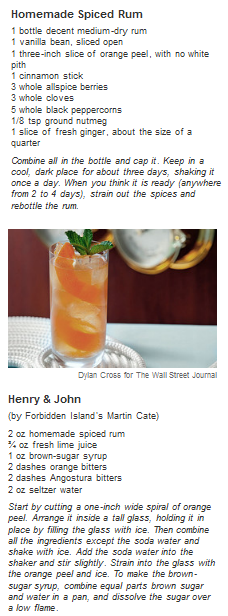
Homemade Spiced Rum
(adapted for the rum used & the DJ's tastes... click the image to the right to get the original recipe)

1 bottle bottle gold rum (Cockspur Five Star)
1 vanilla bean, sliced length-wise
1 three inch piece orange peel
1 three inch piece lemon peel
1 cinnamon stick
3 whole allspice berries
3 whole cloves
3 whole black peppercorns
1 quarter inch piece nutmeg

Combine all in container and seal. Let sit for 2-3 days. When desired flavor is reached, strain and re-bottle.

In order to whet your appetite on what a spiced rum drink can be, let us examine the recipe in the picture to the right. It is called the Henry & John, after (Captain) Henry Morgan and John Pemberton, the inventor of Coca-Cola. Call it a fancy "Cap'n & Coke", but it tastes nothing like it. This drink is created by Martin Cate, a modern day champion and authority on tiki drinks and bartending. Cate just opened up a new bar called Smuggler's Cove in San Francisco, a joint specifically designed to celebrate rum. And I must say, Henry & John is a drink on the order of some of the best rum drinks I've ever had.

Henry & John

2 oz (homemade) spiced rum
3/4 oz lime juice
1 oz brown sugar syrup*
2 dashes orange bitters
2 dashes aromatic bitters
2 oz seltzer water

Wrap a long piece of orange peel inside a tall glass, then fill the glass with ice. Shake all ingredients except the seltzer in a shaker with ice. Open the shaker, add the seltzer, then strain onto the ice in your glass with the orange peel.

*Recipe is in the image above.

Final note: be classy and save your prettiest booze bottles to house your finished infusion masterpieces.